


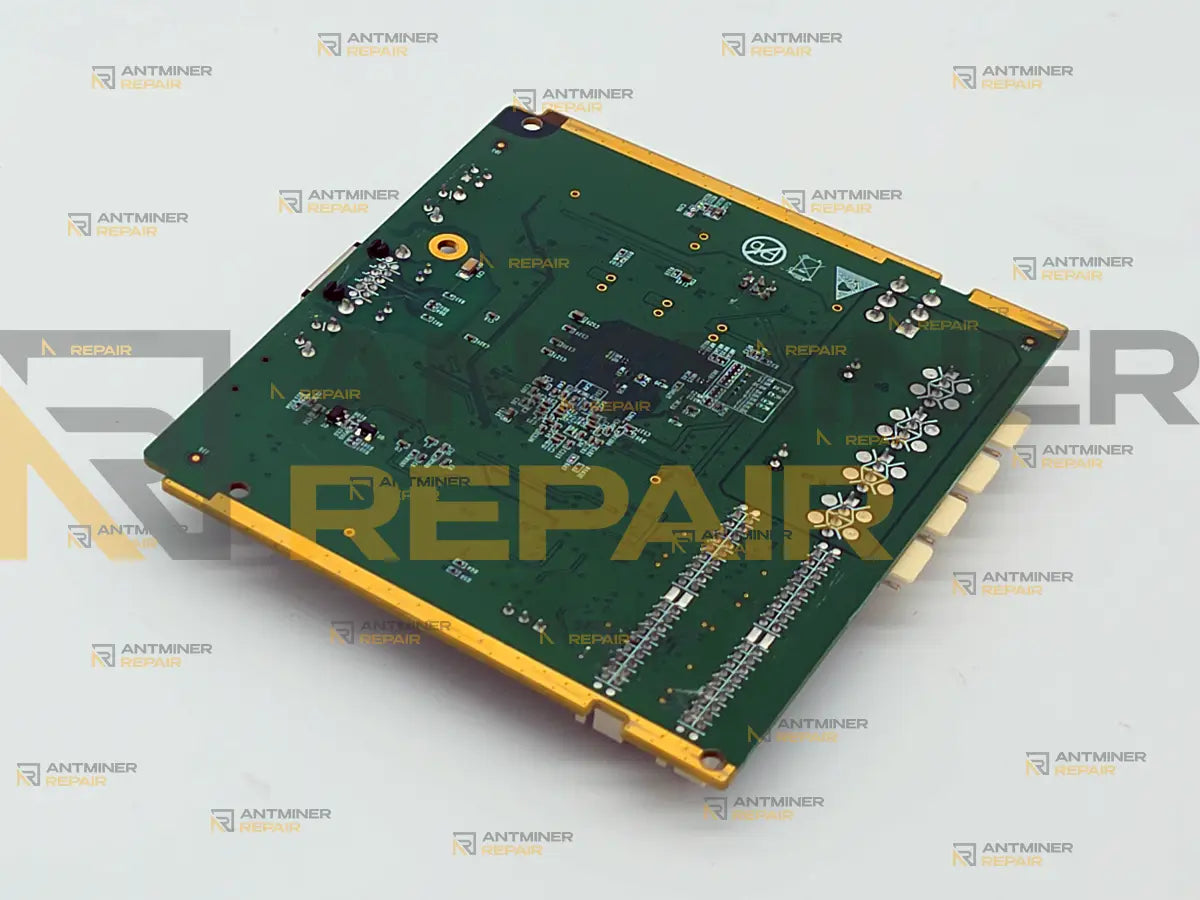
People land here after searching CVITEK control board repair. On a CV1835 the fix is a new board rather than a repaired one, because bench time on a dead board costs you more than a tested board does. We prove the controller is what failed, fit the matching CVITEK board, and validate the miner under load.
A CVITEK control board and a Xilinx one are the same shape, the same single PCB, and both put a card slot on the front panel beside the Ethernet jack. From the port edge there is nothing to tell them apart — and that is not a cosmetic detail. Get the two mixed up and you write the wrong firmware, and a board that was working stops booting. Most of what follows on this page exists because of that one problem.
Telling a CVITEK board from a Xilinx one
There is exactly one check that settles it, and it is not the card slot.
| Family | Card slot | What the main chip says |
|---|---|---|
| CV — CVITEK | On the front panel, beside the Ethernet jack | CVITEK CV1835 |
| XIL — Xilinx | On the front panel too — indistinguishable from the outside |
XILINX, ZYNQ and a part number starting XC7Z
|
| AML — Amlogic | None at all. A micro-USB port instead | AMLOGIC A113D |
| BB — BeagleBone | Inside, on the board itself — the case has to come apart | Texas Instruments Sitara AM335x. Two boards stacked, not one |
Read down that table and the shape of the problem is obvious. An Amlogic board announces itself by having no card slot — you can rule it out through the front panel without opening anything, and it is covered on our Amlogic A113D control board replacement page. A BeagleBone controller is two circuit boards stacked into one assembly, which nothing else in the range looks like, and it has its own BeagleBone control board replacement page. But CVITEK and Xilinx are both a single board with a slot on the front, in the same position, next to the same jack. The processor marking, and the components sitting around it, are the only things that separate them — and the marking is decisive: CVITEK CV1835 on one, XILINX ZYNQ with an XC7Z part number on the other. Nothing on the port edge will help you: not the slot, not the connector layout, and not a heatsink, because no Antminer control board of any family has one. If yours says Zynq, you want the Xilinx Zynq control board replacement instead of this page.

What happens when the two get mixed up
Firmware is built per board family, not per miner model. An image compiled for a Zynq board writes itself onto a CV1835 and the board stops booting. Because the card slot is right there on the front panel and looks inviting, this is the easiest mistake to make on these two families.
The honest version, which is not what most pages tell you: this is a software fault, and the way back is to write the correct image for your miner and your board family. What makes it painful is that the CV1835 is unusually fussy about the card it is asked to read. Not every card will flash it, a card that works on one board will refuse on another, and it is normal for the same card to take two or three attempts before the board takes the image. People read that as a dead board long before it is one.
So the most useful advice on this page is short. If you are not certain which family you have, do not flash anything. Photograph the main chip and photograph the port edge, send both with your enquiry, and we will tell you what is in the machine. That costs you nothing and takes an hour of our time at worst; the alternative is hours of your evening spent proving that a board is not dead.

CVITEK CV1835 on the main processor, with a memory device either side of it. A Xilinx board reads XILINX ZYNQ in the same place.What actually kills these boards
Dead controllers are real, and plenty of them reach us. But the cause is usually not the one people expect.
The commonest killer we see is mechanical, not electrical: hashboards that are not bolted down tightly onto the power bus bars. A joint that is not properly torqued is what takes the control board with it, and that is not a CVITEK problem — it kills controllers of every family, on every model. If you take one practical thing from this page, take that one: when a machine goes back together, the bus bar hardware gets checked.
The second cause is a flash that was interrupted rather than wrong — power lost partway through a write. A completed write of the wrong image is recoverable; a write that stopped halfway is the case that ends in a bench.
Is it the control board?
A dead control board leaves you nothing to read. It produces no error page and writes no log, because it never gets far enough to write one — the symptom is the absence of things that should be there:
- The miner does not come up at all: no web interface, no address from DHCP, no answer to a ping or a network scan
- It starts and never finishes — a reboot loop, or a machine that sits there and never serves a page
- The IP report button produces nothing, where a working board would announce itself
- It reaches the network but reports fewer hashboards than the miner has, or none
- Visible damage: a scorched area near the Ethernet jack after a supply event or a storm, a melted connector, a burnt smell
Now the part that decides whether shipping the miner is worth it. A dead power supply and a failed hashboard produce the same outward picture as a dead control board — a machine that will not come up. Spinning fans do not clear the power supply, because on these miners the fans can run from their own line while the board has no supply at all. So the work starts with a diagnosis rather than with a part: we fit a known-good CVITEK board and retest, and if the fault survives the swap it was never the controller. That is the method Bitmain publishes for its own machines, and performing it needs a second known-good board and a second chassis — which is precisely what an owner with one miner does not have.
Why replacement, not repair
The reason is arithmetic, not a limit on what can be done. We can follow a CV1835 board through its start-up and say where it stops. What we cannot do is make component-level work on it come out cheaper for you than a tested board does. The processor is a BGA package, so the work is rework under a hot-air or infrared station rather than something touched with an iron, and the memory beside it is worth a few dollars. That means the bill for that work is bench hours and equipment rather than parts — and at the end of those hours you own a board with a reworked joint on it instead of a board that already works.
Two things belong in the open rather than in the small print.
Some faults are localised enough that replacing the whole board would be overkill. A cracked Ethernet jack or a fatigued ribbon header is damage in one place, and the guides written for boards of this class recommend re-soldering rather than scrapping. They also warn that a re-flowed joint can crack again within days of going back under load. That is a reason to diagnose the board before anything is fitted, rather than a service to build around.
The arithmetic depends on which miner you own. On a T21, an L9 or a liquid-cooled unit it is not close — the controller is a small fraction of what the machine is worth, and those miners are worth keeping alive. On an older air-cooled S19 the gap between a control board and a working second-hand miner of the same model has narrowed enough to be a fair question, and we would rather you asked it before shipping than after.
Hardware Notes
| Specification | Details |
|---|---|
| Board family | CV — CVITEK. One of Bitmain's four control board families, alongside Xilinx (XIL), Amlogic (AML) and BeagleBone (BB) |
| SoC | CVITEK CV1835. On the boards we have opened the package sits at designator U1 and reads CVITEK CV1835 AB5010000 TC4W48 2120A. A vision processor by origin, not a mining part — and the only marking that identifies this family with certainty |
| Heatsink over the processor | None. The die is bare. Worth stating because a widely copied identification guide claims a heatsink marks out a Xilinx board — it does not, and no Antminer control board of any family carries one. Do not use a heatsink, or its absence, to identify anything |
| Programmable logic | None. Xilinx is the only one of the four families with FPGA fabric, which is why the Xilinx-only fault of booting cleanly and hashing zero does not appear here |
| Firmware storage | Onboard managed flash — a SiliconGo SGM8000C-S30B4G at U2, read off our own boards — plus a removable card slot on the front panel, in the same place a Xilinx board carries one. The card is the way firmware is written into that onboard flash, not the medium the board runs from. That distinction settles a question the rest of the internet argues about, and the accessible slot is exactly why the two families get confused |
| Ports and layout | Single PCB, not a stacked pair. Ethernet on the front panel with the card slot immediately beside it, a button at S2 next to the jack, and discrete Ethernet magnetics at T1
|
| System memory | Bitmain publishes nothing and no supplier lists it, so this comes off our own bench: two ESMT M15T1G1664A devices sitting either side of the processor. We quote the marking we read rather than a capacity we cannot source |
| Revision codes | Bitmain publishes no revision list, and sellers usually list these boards by the processor name. The boards themselves do carry a code: ours are labelled Model: Ctrl_C97 V3.2010. Sellers also ship Ctrl_CB8, Ctrl_CB4 and Ctrl_C88 as CVITEK boards. We list what we have seen rather than a revision table we cannot stand behind |
| Silkscreen |
Miner_Ctrl_Board_CV1835_V3.2 printed along the board edge, and a label carrying the model, the works order and the serial |
| Cross-family fit | None. A Xilinx-era image on a CVITEK board, or the reverse, stops the board booting until the correct image is written back — and these two are the pair most often mistaken for each other |
| Where it came from | The CVITEK platform appeared first in the S19 XP and spread down the line from there. Bitmain never announced the change, so treat that as an industry observation rather than a manufacturer statement |
| Coverage | Any model on this platform, any revision. There is no supported-models list to check first |

Which miners take a CVITEK board
Boards of this family turn up in fourteen positions across the Antminer range, and the column on the right is the point of the table: in thirteen of the fourteen, the model on the sticker does not tell you what is inside the chassis.
| Miner | Other families also fitted to this model |
|---|---|
| S19, 88-chip build | Amlogic, BeagleBone, Xilinx |
| S19, 126-chip build | Amlogic |
| S19j | BeagleBone, Xilinx |
| S19j+ | Amlogic, BeagleBone, Xilinx |
| S19j Pro | Amlogic, BeagleBone, Xilinx |
| S19j Pro A | Amlogic, BeagleBone |
| S19j Pro+ | Amlogic, BeagleBone, Xilinx |
| S19j XP | Amlogic, Xilinx |
| S19 XP | Amlogic, Xilinx |
| S19k Pro | Amlogic, Xilinx |
| T21 | Amlogic, Xilinx |
| L9 | Amlogic |
| S21+ Hydro | Xilinx |
| S19 XP Hydro U3 | None. CVITEK only |
The one machine where the model does settle it
The S19 XP Hydro U3 is the exception in the whole Antminer range: every unit we have mapped carries a CVITEK board, and no build for any other family exists for it. If that is your machine, you already know what is inside it without opening anything — which is not true of a single other model on the list above.
Liquid cooling does not mean Xilinx
The S21+ Hydro exists with a CVITEK controller and with a Xilinx one, so on that machine the cooling type tells you nothing about the board. Worth saying plainly, because the long C59 and C89 boards fitted to most of the liquid-cooled range are Xilinx, and it is easy to generalise from that to the whole Hydro line. If your miner is liquid-cooled, start on the Antminer Hydro control board replacement page — it covers the long-board format and the cooling-loop faults that imitate a dead controller, and the two Hydro machines listed above are identified on the bench either way.
And in the other thirteen, the model decides nothing
After Xilinx, CVITEK turns up in the widest spread of models of the four families, and apart from Amlogic it is the only one that reaches across the 19 series, the T21 and the Scrypt L9 at once. The consequence is on the right-hand column above: the same model number left the factory with a CVITEK board in one production run and an Amlogic, BeagleBone or Xilinx board in another. Two S19j Pro units side by side can want completely different parts. The sticker narrows the field; only the marking on the board settles it.
Bricked after a firmware update?
A miner that went down during or after an update is the one case nobody answers by email, us included. It may need its software restored and it may be a dead board, and from where you are standing those look identical — a controller showing no lights at all is often perfectly recoverable, because corruption stops the start-up before the lights are ever initialised. On this family there is also the specific route described further up the page: an image built for another board family writes successfully and leaves the CV1835 refusing to boot. That one is software, and the correct image for your model and board family is the way out of it — the case that turns into hardware is a write that was interrupted partway. Working the other way round, plenty of miners that look like a failed update turn out to have had a hardware fault all along, which the reboot merely exposed. If what your machine needs is software rather than hardware, that is covered in our Antminer firmware section. If nobody can tell which of the two it is, that is a diagnosis, and a diagnosis needs the machine on a bench.
Which boards, and what to check before ordering
We cover any model and any revision on this platform. There is no supported-models gate here and nothing to check against a list before you contact us.
Matching becomes your problem in one situation only: you are buying a bare board and fitting it yourself. Then the family has to be right before anything else is considered, and the family is the processor marking — not the presence of a card slot, which proves nothing here. Ordering by miner model alone is how a Zynq board arrives for a CVITEK machine, and that mistake is worse than a board that will not seat, because this one physically fits and then refuses to boot on the first flash. If we are doing the replacement, matching the board to your miner is our job. Send the machine and we will work out what belongs in it.

What happens after intake
- Intake and incoming inspection. We record the condition as received, the processor marking, the connector layout and any visible damage, along with what the miner was doing when it stopped
- Diagnosis. We establish whether the control board is the fault rather than assuming it — separating it from the power supply and the hashboards with a known-good board, and following the start-up sequence through the service port where the machine does not come up at all
- Fitting. The correct CVITEK board goes in, and the hashboard-to-bus-bar hardware is checked and torqued on the way back together
- Firmware and configuration. The board is brought up on the right configuration for the machine it is going into. Boards do not arrive configured for your unit
- Validation under load. The miner runs under real mining load and we check for all hashboards present and a stable hashrate — not just a board that boots — before it ships back
Before you ship, two things we would rather you heard from us
Your old board is disposed of. We do not keep removed boards in storage. If you want yours back, say so before the work starts — once it is gone we cannot retrieve it.
Expect the hashboards to need attention too. In the units that reach us a control board fault rarely arrives on its own, and that is the honest reason turnaround stays at 4-5 business days instead of being quoted as a same-day swap. It is not an upsell, it is the shape of the actual work: one intake, one diagnosis, one shipment, instead of fitting a board and finding the real problem afterwards. If your miner needs board-level work as well, we handle both in the same visit.
All work is performed personally by Alex, who has been servicing ASIC miners since 2019. See credentials →
Send the whole miner rather than the board on its own. Bitmain gives the same advice for its own service, because a board tested by itself carries no guarantee that it will work in your specific machine, and a fault that arrived alongside the board gets missed entirely when only the board travels. Contact our repair team today and get your miner back to full power.