


BITMAIN
Antminer BB (BeagleBone) Control Board Replacement Service
Antminer BB (BeagleBone) Control Board Replacement Service
By placing your order you agree to our Terms of Service, Warranty Terms and Refund Policy.
Drop off available in Fort Lauderdale, FL (2141 NE 51st Ct).
Repair guide last verified: 30 August 2026
XILINX ZYNQ · CVITEK CV1835 · AMLOGIC A113D · Sitara AM335x▸How to ship your hardware
Share


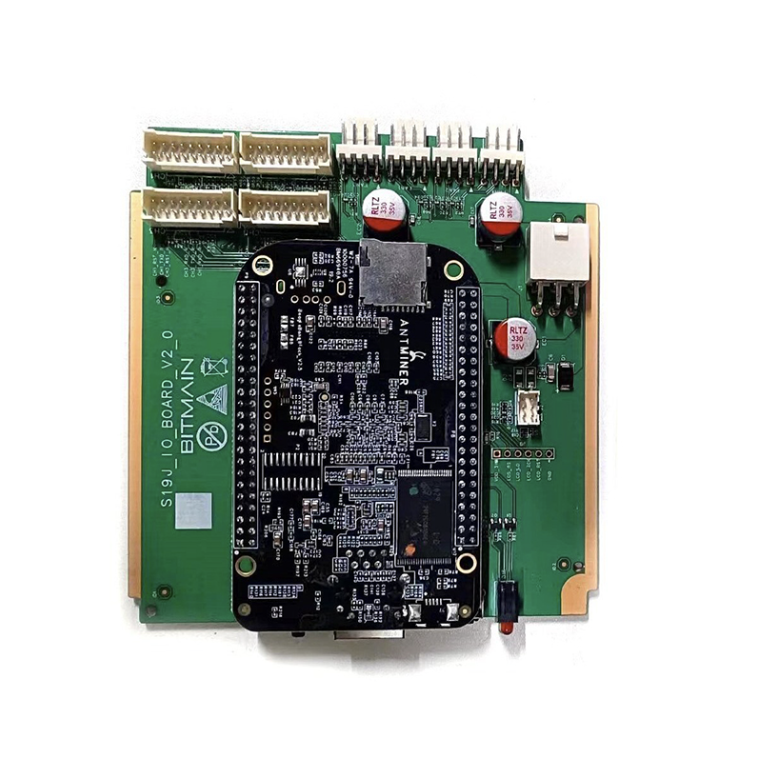
Looking for BeagleBone control board repair on an Antminer? Repair is not the service that fixes it. A BB controller is replaced, because the board comes apart into two halves that each cost less than an hour at the bench. We prove the controller is what failed, fit a matching board, and run the miner under load before it ships.
The BeagleBone control board is the one you cannot identify without opening the machine, and the only one of Bitmain's four families that never travelled alone: every miner it was fitted to also left the factory with a Xilinx, Amlogic or CVITEK controller in other production runs. So the sticker on your miner cannot answer the question here. The board can, and it takes about a minute to read.
Which board is in your miner?
Start with the lid still on. What sits beside the Ethernet jack rules two families in or out before you touch anything.
| What the front panel shows | What it means |
|---|---|
| A memory card slot beside the Ethernet jack | Not a BeagleBone. Only Xilinx and CVITEK boards put the card slot where you can reach it |
| A micro-USB port and no card slot | Amlogic. That family has no card slot anywhere on the board |
| Neither one — just the Ethernet jack, a button and the LEDs | BeagleBone is the candidate, and the lid has to come off to confirm it |
Two of those three answers belong on another page, and following them beats ordering on a guess. A card slot on the front panel means a Xilinx Zynq control board replacement — or a CVITEK board, which is identical from the port edge and is separated from Xilinx only by the marking on its main chip, CVITEK CV1835, and has a page of its own: CVITEK CV1835 control board replacement. A micro-USB port with no slot means an Amlogic A113D control board replacement.
With the lid off, a BeagleBone controller is unmistakable, for a reason nothing else here shares: it is two circuit boards stacked, a processor module seated on a carrier board, joined by a pin header along one edge. Three things confirm it, and any one of them is enough:
-
The processor. A Texas Instruments
AM3352at positionU5on the upper module, withAM335xprinted on the board beside it -
The labels. The module is marked
Ctrl_BF0; the carrier under it readsS19J IO BOARDin the silkscreen and carries its ownCTRL_I90sticker. Two boards, two part numbers, two serial numbers - The card slot. It exists, but it is on the board itself, inside the machine. That is why the front panel is bare, and why nothing involving the card can be done without opening the miner
If the marking is hard to read, photograph the processor and the port edge and send the pictures with your enquiry. We would rather identify the board for you than have you order the wrong one.
Which miners take a BeagleBone board
The rule is the chip, not the model name. In the machines that reach our bench, a BeagleBone controller drives BM1362-generation hashboards and nothing else. That single fact defines the whole range, and it is more useful than any table, because it also tells you when the answer is no.
In practice that means the 88-chip S19, the S19j, and the S19j Pro in all its builds — including the S19j+ and the S19j Pro+. The S19j Pro A follows from the same rule, although we have not had one on the bench to confirm it.
It also means the answer is no for a good deal of the 19 series. A plain S19 or S19 Pro of the earlier build, an S19 XP, an S19k Pro — those are different chip generations, and a BeagleBone board is not the part for them. Neither is anything in the S21 family, the L series, or any liquid-cooled machine. If your miner is one of those, this page is not your page, and the model number is enough to tell.
| Miner | Other control board families found in the same model |
|---|---|
| S19, 88-chip build | Amlogic, CVITEK, Xilinx |
| S19j | CVITEK, Xilinx |
| S19j+ | Amlogic, CVITEK, Xilinx |
| S19j Pro | Amlogic, CVITEK, Xilinx |
| S19j Pro A | Amlogic, CVITEK |
| S19j Pro+ | Amlogic, CVITEK, Xilinx |
The right-hand column is the point of this page. There is not one model on that list where BeagleBone is the only possibility. Every one of them also shipped with a Xilinx, Amlogic or CVITEK controller in other production runs, which makes this the family where the model number tells you least. Two miners with the same sticker, standing side by side, can hold different controllers, and only opening them settles which. Bitmain never published a model-to-board list, and the batch documentation that does exist describes what left the factory together — not what the board is able to drive.
The family arrived in the second half of 2021, when Bitmain moved from Xilinx controllers to a reworked BeagleBone Black design. The reason usually given is a shortage of Xilinx parts, and it is worth being straight about the evidence: the people who documented the switch put it as an observation rather than something Bitmain confirmed. The dates are firmer than the reason — the two boards sitting on our bench as this was written carry factory dates of June and October 2021.
Is it the control board?
A dead controller writes nothing down. It never gets far enough to record an error, so the symptom is an absence rather than a message, and it takes one of these shapes:
- Nothing at all. No web interface, no address from DHCP, no answer to a ping or a network scan, and no announcement from the IP report button
- It starts and never finishes. A reboot loop, or a machine that sits with the fault light on and never serves a page
- It comes up and cannot see the chains. The interface answers, but one, two or all three hashboards are missing
- Visible damage. A scorched area near the Ethernet jack after a storm or a supply event, a melted connector, a burnt smell
Now the part most pages skip. None of that proves the control board is at fault. A dead power supply and a failed hashboard produce the same outward picture. Fans that spin prove nothing either, because on these machines they can run from their own line while the board has no supply at all. Voltages that measure correctly do not clear the board, and a board with no lights at all is not necessarily gone — corruption can stop the boot before the lights are ever initialised. On a BeagleBone machine an owner has one route fewer than on the other families: the card is behind the lid, so starting from known-good software is not a five-minute check you can run in a rack.
That is why the work starts with a diagnosis instead of a part. We fit a known-good BeagleBone board and retest — if the miner comes up, the board was the fault; if the fault survives the swap, it never was. Bitmain publishes the same method for its own machines. It needs a second known-good board and a second chassis, which is exactly what an owner with one miner does not have.
The miner powers on but never shows an IP address
This is the most common way a dead controller announces itself, and also the symptom most often blamed on it wrongly. Work down the list before you suspect the board:
- Check the lease table on your router rather than the scanner — a miner that took an address and then stopped answering is a different fault from one that never took an address at all
- An address in the
169.254.x.xrange means DHCP never answered, which is a network problem and not a board problem - Put a laptop on the same cable and the same switch port, then try the miner on a port you have just proved
- Press the IP report button. A working board announces itself; silence is a data point, not a verdict
Two outcomes point hard at the board. Both indicator lights dark while the power supply is clearly alive is the case Bitmain itself resolves to a faulty control board. And both Ethernet jack lights dark after you have changed the cable, the port and the switch puts the fault in the jack, the magnetics or the network chip on the board — components that no reflash reaches.
All three hashboards disappeared at once
Start with how many chains are missing, because the answer changes completely.
One chain gone, the other two mining normally. That is nearly always the hashboard itself — a failed chip, a cracked joint, a heatsink that let go. A controller fault that takes out exactly one chain and leaves the neighbours untouched is rare. That is a job for S19j Pro hashboard repair rather than a new controller, and sending the miner for the wrong service costs you a shipment.
All three gone together. Three hashboards do not usually die on the same night, so the honest move is to look at what all three have in common: the power path, the ribbon cables, the fan and protection logic, and the controller that talks to them. Logs in this state say things like Data load fail for chain 0 repeated for each chain, or ERROR_SOC_INIT: basic init failed! followed by the miner powering the hashboards off, or a chain reporting zero chips where it should report a full set.
What we will not tell you is that this means your control board is dead. In machines of this generation the same picture has resolved to a loose power lead under the supply cover; to fan simulators on an immersion unit; to a pool that refused the work; and to hashboard data that had genuinely gone, on a miner whose owner had already replaced the controller twice without result. It has also resolved to the controller. The difference is established on a bench, by swapping one known-good part at a time, and it is why we diagnose before we fit.
Errors that appeared right after a board was swapped
If you fitted a replacement controller yourself and the miner now reports faults it never had, look at the log before you conclude the new board is bad. Lines like board name doesn't match, or a firmware type and an EEPROM value that disagree, or a complaint about more than one board type being present, all say the same thing: the controller and the hashboards are not a matched set. The hashboards carry their own identity and calibration data, and the controller has to be running software that expects exactly what it finds.
This is ordinary, it is fixable, and it is the single best argument for not buying a bare board on a model number. When we do the replacement, matching the board and its configuration to your miner is our problem rather than yours.
What a control board fault does not explain
Some symptoms send people to this page and should not. Saying so costs us a sale and saves you a shipment.
- Over-temperature shutdowns. Almost always airflow, ambient temperature or a blocked intake. One documented case was cured by air conditioning in the room
- A single fan reading zero while it visibly spins. Suspect the fan and its tach line first; a failing fan can also produce a phantom reading the board faithfully reports
- One dead chain out of three. Hashboard, as above
- Pool errors while the interface works. The board is plainly alive if it is serving you a page and talking to the network
Control board, hashboard or power supply
The three look alike from outside. This is how we separate them, and how you can narrow it down before shipping anything.
| What you see | Most likely | Best next test |
|---|---|---|
| No lights, no fans, nothing | Power supply, before anything else | A known-good supply, and a look at the leads under its cover |
| Fans spin, no lights, no address | Control board — fans can run on their own line | A known-good controller in this chassis |
| No address, link light on | Network, DHCP or configuration | Router lease table, then a proven cable and port |
| One chain missing | That hashboard | Move its ribbon to a port you know works |
| All three chains missing | Something common to all three: power path, cables, fan logic, or the controller | Known-good controller first, then the hashboards in a known-good miner |
| Faults began after a firmware update | Software or a dead board — indistinguishable from outside | A bench, not an email |
| Faults began after you swapped the controller | Controller and hashboards are not a matched set | Read the board name and EEPROM lines in the log |
| Random shutdowns under load | Supply or site power, then temperature | Check the rack feed and room temperature before parts |
Why replacement, not repair
The reason is arithmetic, not a limit on what we can do. We can follow a BeagleBone board through its start-up and say where it stops. What we cannot do is make component-level work on it come out cheaper for you than a tested board does — and on this platform the sum is not close. The board is two halves that are sold separately as ordinary parts, and either half costs less than an hour at a rework station. Spend the bench time and you own a board with a reworked joint in it, when the alternative was a board that already works and has been proven working under load.
Two things belong here rather than in the small print.
Some faults are localised, and we say so when yours is one. A cracked Ethernet jack or a fatigued cable header is a different problem from a dead processor, and the service guides written for boards of this class recommend re-soldering those rather than scrapping the board. The same guides warn that a re-flowed joint can crack again within days of going back under load. That is precisely why the board is diagnosed before anything is fitted, instead of being sold to you on the strength of a symptom description.
Every miner on this platform belongs to one generation, and that changes the sum. BeagleBone boards were only ever fitted to BM1362-generation machines, and a working second-hand S19j has fallen far enough in price that the gap between a board and a whole miner is a fair question. We would rather you asked it before shipping than after. One thing has not narrowed: a dead unit sold for parts often costs more than a tested board, so buying a broken miner as a donor is usually the worst of the options.
Hardware Notes
| Specification | Details |
|---|---|
| Board family | BB — BeagleBone. One of Bitmain's four control board families, alongside Xilinx (XIL), Amlogic (AML) and CVITEK (CV) |
| SoC | Texas Instruments Sitara AM3352, single ARM Cortex-A8 core, at designator U5 on the upper module. A general-purpose applications processor rather than a part designed for mining — the platform is a reworked BeagleBone Black |
| Construction | Two PCBs stacked — a processor module on a carrier board, joined by a pin header. No other Bitmain control board family is built this way, which makes it the quickest thing to recognise with the lid off |
| Board markings | Processor module: Ctrl_BF0. Carrier: S19J IO BOARD in the silkscreen, CTRL_I90 on the label. Each half carries its own version and serial number |
| Hashboard generation | BM1362. This is the constraint that defines which miners the board belongs in |
| Firmware storage | Onboard NAND, plus a microSD slot on the board itself, inside the machine. There is no front-panel slot, so reaching the card means taking the miner apart |
| Front panel | Ethernet jack, IP report and reset button, status LEDs. No card slot and no micro-USB — here the absence is the identifying feature |
| System memory | Not published by Bitmain and not listed by suppliers. We would rather leave this blank than quote a figure we cannot verify |
| Hashboard interface | Three chains, one ribbon header each — every miner this board was fitted to is a three-hashboard machine |
| Generation | Second half of 2021 onward. Boards we have on hand carry factory dates from June and October 2021 |
| Cross-family fit | None. An image built for another control board family is a reliable way to kill a working board, and it works in both directions |
Bricked after a firmware update?
A miner that went down during or after an update is the one case nobody can answer by email, us included. It may need its software restored and it may be a dead board, and from where you are standing the two are indistinguishable. This family adds a practical wrinkle: the card sits inside the machine, so even establishing what state the software is in means opening the miner. There is also a way an update turns into a hardware fault rather than a software one — an interruption partway through a card recovery can damage the processor beyond what any reflash reaches, which is why power during that operation matters more than people expect. If your unit needs software work rather than hardware, that is covered in our Antminer firmware section. If nobody can tell which of the two it is, that is a diagnosis, and a diagnosis needs the machine on a bench.
Coming from a locked Amlogic board
Not everyone who orders this board has a dead one. A second group arrives with a perfectly healthy miner and a different problem: their machine shipped with an Amlogic controller, later stock firmware closed the door on installing anything else, and they want the choice back. A BeagleBone controller is a common way to get it, because this platform installs from a card rather than through a port that can be shut.
Two honest notes before you order on that basis. Figures you will read on forums for what a re-controlled miner can do are other people's results on other people's power, and we will not repeat them as a promise. And the swap is a physical job as well as a software one: the board has to sit in the chassis, the ribbons have to reach, and the machine has to come up on a configuration that matches the hashboards it already has. If you would rather not find that out by trial, send the miner and we will fit and configure it.
Which boards, and what to check before ordering
We cover any model and any revision on this platform. There is no supported-models gate here, and nothing for you to check against a list before getting in touch.
Matching becomes your problem in one situation only: you are buying a bare board and fitting it yourself. Then the family has to be right before anything else does, and the family is the one thing you cannot see from outside on this platform. A board bought because a seller listed your model number is a coin toss, since the same model number left the factory with four different controllers. If we are doing the replacement, matching the board to your miner is our problem rather than yours. Send the machine and we will work out what belongs in it.
What happens after intake
- Intake and incoming inspection. We record the condition as received, the board construction and markings, the connector layout and any visible damage, along with what the miner was doing when it stopped
- Diagnosis. We establish whether the control board is the fault instead of assuming it — separating it from the power supply and the hashboards with a known-good board, and where the machine does not start at all, following the start-up sequence through the service port to see which stage it fails at
- Fitting. The correct BeagleBone board goes in and every connection is checked
- Firmware and configuration. The board is brought up on the right configuration for the machine it is going into, matched to the hashboards already in it
- Validation under load. The miner runs under real mining load, and we confirm all three hashboards are present and the hashrate is stable before it ships back
Before you ship, two things worth knowing
Your old board is disposed of. We do not keep removed boards in storage. If you want yours back, say so before the work starts — once it is gone we cannot retrieve it.
Expect the hashboards to need attention too. In the units that reach us a control board fault rarely arrives on its own, and that is the honest reason turnaround stays at 4-5 business days rather than being quoted as a same-day swap. It is not an upsell, it is the shape of the actual work: one intake, one diagnosis, one shipment, instead of fitting a board and finding the real problem afterwards. If your miner needs board-level work as well, we handle both in the same visit.
All work is performed personally by Alex, who has been servicing ASIC miners since 2019. See credentials →
Send the whole miner rather than the board on its own. Bitmain gives the same advice for its own service, because a board tested by itself carries no guarantee that it will work in your specific machine, and a fault that arrived alongside the board gets missed entirely when only the board travels. Contact our repair team today and get your miner back to full power.