


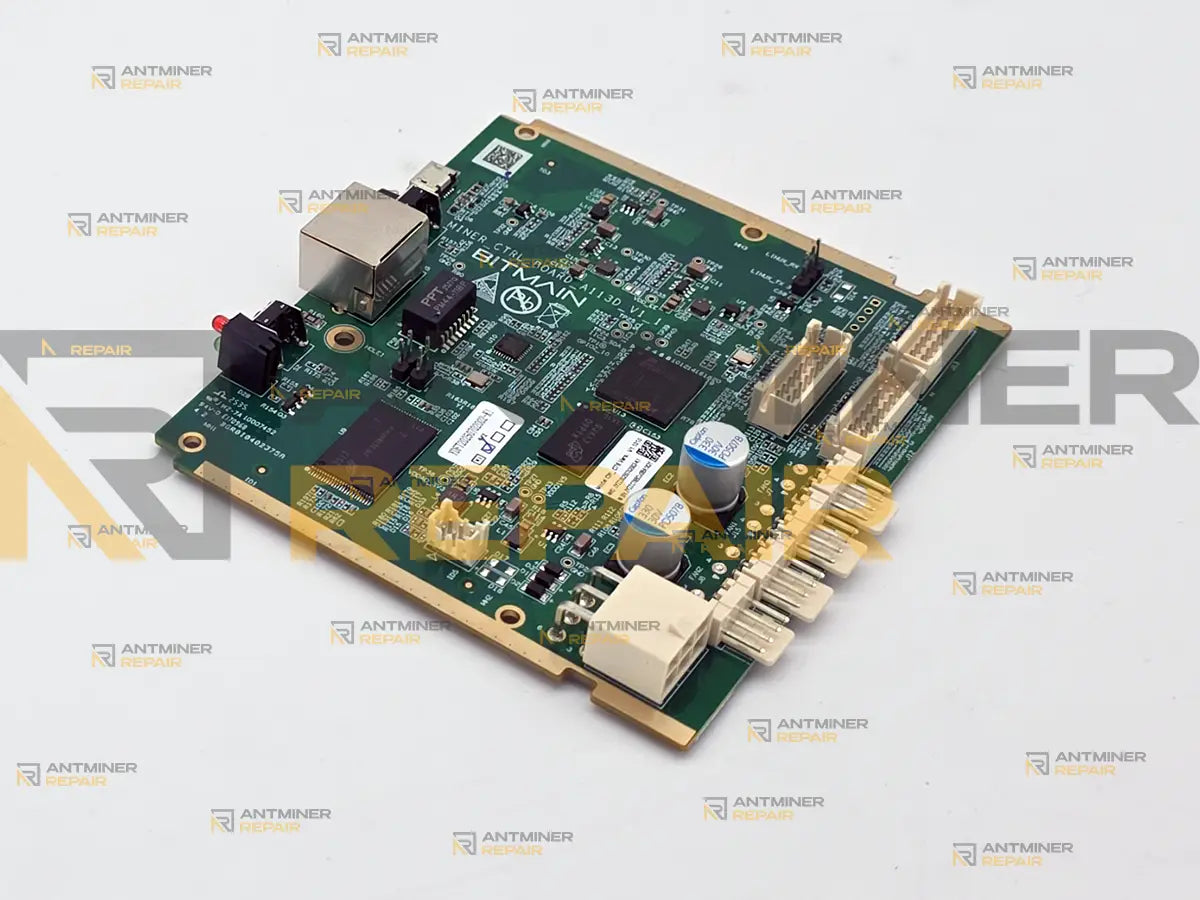
Searching for Amlogic A113D control board repair? AML control boards are replaced, not repaired — a new tested board costs less than component-level work on a dead A113D. We confirm the control board is the actual fault, fit the matching AML board, and validate the miner under real mining load.
The AML control board is the one with Amlogic A113D printed on its main chip, and when it dies the miner gives you nothing to work with: no web interface, no IP, no answer to a ping. Bitmain fitted this platform to some production batches of the S19 and S21 families and fitted Xilinx, BeagleBone or CVITEK boards to others, so the first question on any suspected AML fault is not how to replace the board — it is what is actually in the chassis, and whether the board is actually what failed.
Is it the control board?
A dead control board does not report anything. It produces no diagnostic output, no error page and no log to read, because it never finishes starting. That absence is the symptom, and it looks like this:
- The miner does not come up at all — no web interface, no IP address from DHCP, no response to a ping or to a network scan
- It never finishes booting, or it restarts in a loop without ever serving a page
- The IP report button produces nothing, where a working board would announce itself
- It reaches the network but reports fewer hashboards than the miner has, or none
- Visible damage: a burnt smell, a scorched area near the Ethernet jack after a storm or a supply event, a melted or cracked connector
Here is the part most pages leave out. A dead power supply and a failed hashboard look exactly the same from outside — a miner that will not come up. Fans spinning proves nothing either, because on these machines the fans can run from a separate line while the board itself has no power. This is why the work starts with diagnosis rather than with a part. We fit a known-good AML board of the same type and retest: if the miner comes up, the board was the fault; if the same fault survives, it was never the board. That is also the method Bitmain publishes for separating a control board fault from a hashboard fault, and it needs a second known-good board and a second chassis to perform — which is precisely what an owner with one miner does not have.
Why replacement, not repair
The honest reason is money, not capability. We can diagnose an A113D board down to which stage of its start-up sequence fails. What we cannot do is make component-level work on that board cost the customer less than a tested board costs, and there is no point pretending otherwise. A replacement AML board is an inexpensive part; the bench hours needed to chase a dead SoC, corrupted onboard flash or a damaged one-time-programmable region are not, and the result carries less confidence than a board that already works.
Two things are worth saying plainly instead of hiding them.
Some faults genuinely are worth working on. A cracked Ethernet jack, a fatigued cable header, a single obvious cold joint — those are localised, and shops that take that work on quote five to ten business days for it, with the caveat that a re-flowed joint can crack again within days of going back into service. We do not build a service around that outcome. It is also the reason the board is diagnosed before anything is fitted, rather than sold to you on the strength of a symptom description.
The economics depend on which miner you have. On an S21-generation machine the arithmetic is not close: the board is a small fraction of what the miner is worth. On an older S19-generation unit the gap between a board and a used miner has narrowed enough that it is a real question, and we would rather you ask it before shipping than after.
The three AML builds
Same processor, same firmware family, three different boards. The fan plug is what tells them apart at a glance.
| Board | Fan plug | Fitted to |
|---|---|---|
| Standard width | Flat 4-pin | S19 XP, S19j Pro, S19k Pro and the other 19-series builds listed below — not the plain S19, S19 Pro, S19j or T19 |
| Standard width | Square 4-pin | S21, L9 |
| Wider board | Square 4-pin | S21 Pro, S21 XP, S21+ |
Hardware Notes
| Specification | Details |
|---|---|
| Board family | AML — Amlogic. One of Bitmain's four control board families, alongside Xilinx (XIL), BeagleBone (BB) and CVITEK (CV) |
| SoC | Amlogic A113D, quad-core, in a compact BGA package |
| System memory | DDR3L SDRAM. Supplier varies by batch — ISSI and Micron parts both turn up |
| Firmware storage | Onboard flash. No SD card slot, no removable media — the clearest difference from Xilinx and BeagleBone boards |
| Ports and controls | Ethernet with onboard magnetics, one micro-USB, two buttons, red and green LEDs |
| Hashboard interface | Three ribbon headers, one per chain. No FPGA — the CPU drives each chain over a software UART |
| Fan headers | Four 4-pin positions, marked FAN1 to FAN4. Plug shape differs by build |
| Silkscreen |
Miner_Ctrl_Board_A113D_AAP4_ENIG_V2.0MINER_CTRL_BOARD_A113D_V1.1White_Ctrl_Board_A113D_AAP4_ENIG_V1.1Sticker label: Model CM_CRD Vers: V1.0010
|
| Seller part codes | C76, C81, C83, CBE V2.0, A113D V1.0010 |
| Cross-family fit | None. An Amlogic-era image on a Xilinx-era board, or the reverse, is a known way to kill a working board |
Which miners use this board
The AML platform turns up across two generations of Antminer. On the 19 series, boards of this type have been supplied for the S19 88-chip and S19 126-chip builds, the S19j+, S19j Pro, S19j Pro A, S19j Pro+, S19j XP, S19 XP, S19 XP+ and S19k Pro. On the newer generation they cover the S21, S21+, S21 Pro, S21 Pro+, S21 XP, S21 Immersion, S21 XP Immersion and S21e Hydro, along with the T21 and the Scrypt model L9.
Two entries on that list are worth reading closely, because they are where most of the confusion starts. A plain S19, S19 Pro, S19j or T19 does not take an Amlogic board at all — those carry a Xilinx controller, and the families only diverge once you reach the 88-chip and 126-chip builds of the S19, which shipped with Amlogic, CVITEK, BeagleBone and Xilinx boards depending on the run. If the sticker on your machine says plain S19 or T19, this is not your page: see our Xilinx Zynq control board replacement instead. The other two families that turn up in those same S19 builds have pages of their own — CVITEK CV1835 control board replacement and BeagleBone control board replacement.
Read that list carefully, because it is not a promise about your machine. Bitmain changed control board suppliers between production runs, and the same model number shipped with Xilinx boards in one batch, BeagleBone in another and Amlogic or CVITEK in a third. Owners have documented buying identical model numbers months apart and finding different platforms inside. The model on the sticker narrows it down. Only the board itself settles it.
How to tell which board you have
This takes about a minute with the lid off, and it is worth doing before you order anything.
-
Read the main chip. The single reliable test. An AML board says
Amlogic A113D QUAD-CORE. A Xilinx board says Zynq, a BeagleBone board says Texas Instruments or Sitara AM335x, a CVITEK board says CV1835 - Look for an SD card slot. There is not one on an AML board. If you can see a card slot, whether from outside the case or once the lid is off, you are not looking at an AML board
- Count the circuit boards. A BeagleBone controller is two boards stacked together, a module plugged into a carrier. AML, Xilinx and CVITEK are each a single board
-
Read the silkscreen along the board edge. If the printed board name contains
A113D, that settles it without needing to find the chip at all - Then look at the fan plug to place it against the build table above


If you would rather not guess, photograph the main chip and the port edge and send the pictures with your enquiry. We would rather identify the board from a photo than have you order the wrong one.
Bricked after a firmware update?
A miner that went down during or after an update is the one case where nobody can give you an answer over email — including us. It may need its software restored, or the board may be gone, and the two look identical from where you are standing. An interrupted update can leave an A113D board unrecoverable rather than merely unbootable: on this platform a power interruption during the one-time-programmable stage damages the main IC itself, which is a hardware outcome and not something a reflash reaches. Equally, plenty of miners that appear to have died from a firmware update turn out to have a hardware fault that was always there and simply surfaced during the reboot. If your unit needs software work rather than hardware, that is covered in our Antminer firmware section. If nobody can tell which of the two it is, that is a diagnosis job, and diagnosis needs the machine on a bench.
Which boards, and what to check before ordering
We cover any model and any revision on this platform. There is no supported-models gate here and nothing to check against a list before you contact us.
Matching matters in exactly one situation: you are buying a bare board and fitting it yourself. The three builds in the table above are easy to confuse, because the processor and the silkscreen family are the same on all of them, and the S21 Pro board is physically wider than the other two. Ordering by miner model alone is how people end up with a board that will not seat or will not take the fan connectors. If we are doing the replacement, matching the board to your miner is our problem, not yours. Send the machine and we will work out what belongs in it.

What happens after intake
- Intake and incoming inspection. We record the condition as received, the board markings, the connector layout and any visible damage, along with what the miner was doing when it stopped
- Diagnosis. We establish whether the control board is the fault, rather than assuming it. That means separating it from the power supply and the hashboards, and where the machine does not start at all, following the start-up sequence through the service port to see which stage it fails at
- Fitting. The correct AML build for your miner is installed and the connections checked
- Firmware and configuration. The board is brought up on the right software configuration for the machine it is going into
- Validation under load. The miner runs under real mining load and is checked for all hashboards present and stable behaviour before it ships back

Two things to know before you ship
Your old board is disposed of. We do not keep removed boards in storage. If you want yours back, tell us before the work starts — once it is gone we cannot retrieve it.
Expect the hashboards to need attention too. In our experience a control board fault rarely arrives alone, and the honest reason turnaround stays at 4-5 business days is that the job is usually not just a swap. This is not an upsell, it is the shape of the actual work: one intake, one diagnosis, one shipment, instead of fitting a board and discovering the real problem afterwards. If your miner needs board-level work as well, we handle both in the same visit.
All work is performed personally by Alex, who has been servicing ASIC miners since 2019. See credentials →
Send the whole miner rather than the board on its own. Bitmain gives the same advice for its own service, because a board tested by itself carries no guarantee that it will work in your specific machine, and a fault that arrived with the board gets missed entirely when only the board travels. Contact our repair team today and get your miner back to full power.