Zyber 8S repair fixes the failure owners of this TinyChipHub home miner report most: a dark display, both fans at full speed, and an AxeOS dashboard that never appears. When the vendor's factory image does not bring the unit back, the fault is on the board, and we repair it at component level in the USA in 2-3 business days.
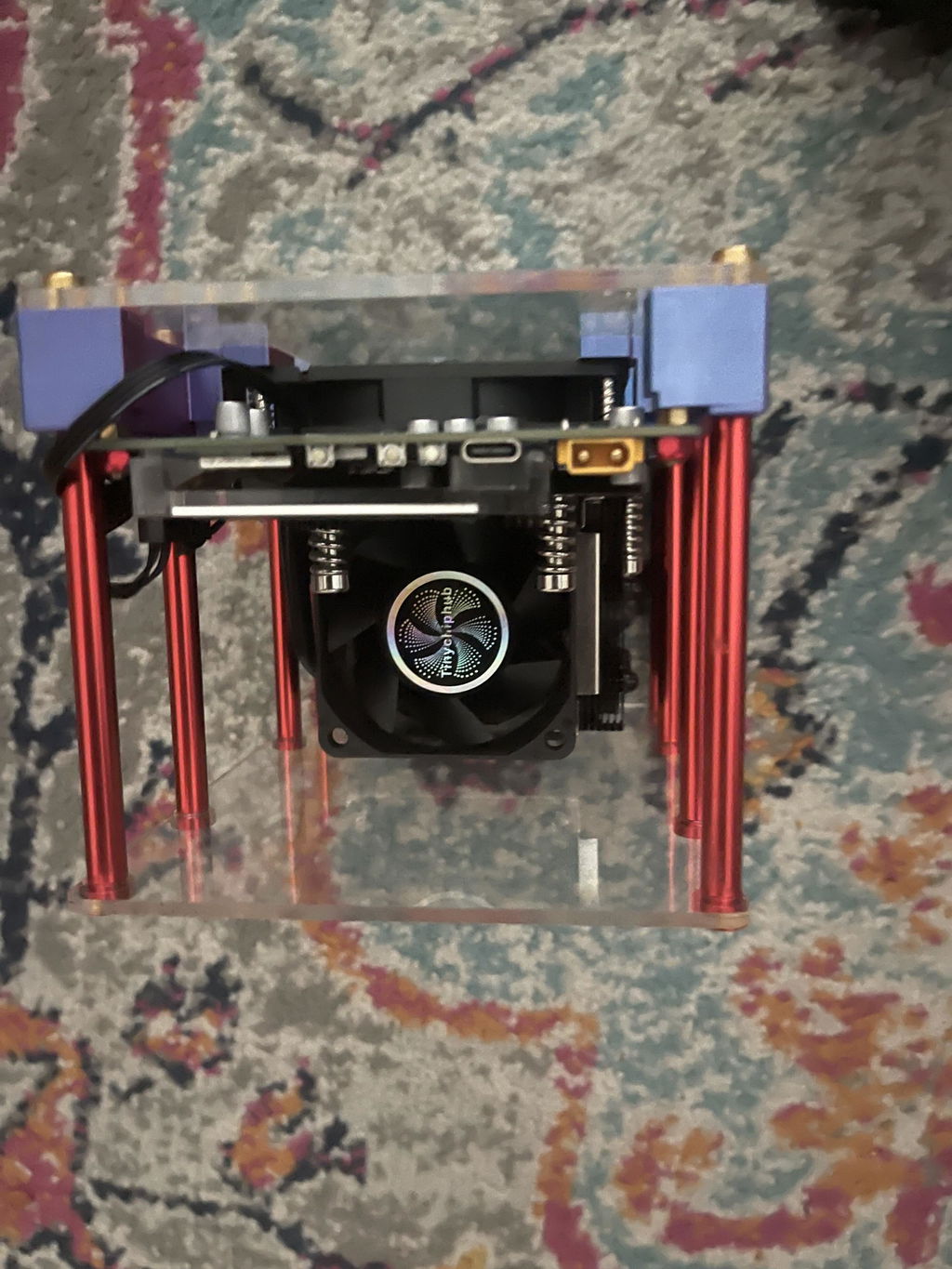
Zyber 8S repair at our USA-based lab covers the complete unit exactly as it sits on your desk: the eight-chip BM1368 board, its power stage, the controller that runs the display and Wi-Fi, and both fans in the stand. This is a complete SHA-256 Bitcoin miner, not a removable hashboard, so it is diagnosed as a whole device: board-level diagnostics, component-level repair, then validation under real mining load through the unit's own AxeOS interface. Working out which part failed is not your job; that is what intake is for.
Technical Diagnostics and Common Issues with Zyber 8S
Quick Symptom Checklist
The messages below are reproduced the way the Zyber 8S firmware prints them. Numbers in brackets and counts differ from unit to unit; the shape of the line is what to match.
- Display stays dark, both fans go to full speed the moment power is applied, and the unit never shows up on the network or in the AxeOS dashboard.
-
chip_monitor_task: Chips reset attemp = 1repeating in the AxeOS log, with the attempt count climbing on each pass. -
Detected 7 ASIC chip(s)at boot, or any count below 8, orASIC initialization failed - chip count 0. A healthy Zyber 8S reports eight; any other figure is a fault. - Hashrate settles well under the 6 TH/s class, or
Too High/Low Hashratekeeps appearing on a unit that is already on current firmware. -
Not available - Power faultorDanger: Low Voltageon the dashboard power card, or the unit restarts and drops off Wi-Fi while it is still hashing. -
Entering safe mode due to overheat condition. System operation halted.in the log, fans pinned at 100%, and the same state returning after every restart.

Model-Specific Patterns We See on Zyber 8S
- Dark display, fans at full speed, no dashboard. From the outside this looks like a crashed firmware, and TinyChipHub's own guide treats it that way. On the Zyber 8S we serviced, it was hardware: the circuit on the board that drives the two fans and reads the temperature sensors had burnt out, most likely after the fan in the base stopped turning, and without that circuit the controller never finishes starting. No reflash changes that. We isolate the failed parts, replace them at component level, and bring the unit back up on its own AxeOS with fan speed and temperature readings verified under load.
- Fewer than eight chips, or a hashrate that reads one chip short. The Zyber 8S runs its eight BM1368 chips across four voltage domains. A unit that hashes at roughly five TH/s instead of six, or reports a chip count below eight once the board is warm, usually has one chip or one domain failing under temperature. We test domain by domain under load, replace the BM1368 that fails, and recalibrate the core voltage afterwards, because a replaced chip alone does not return the unit to rated output.
- Firmware that was never meant for this board. The Zyber 8S runs TinyChipHub's fork of ESP-Miner with the AxeOS interface, and its updater does not check which image it is given. A stock Bitaxe or OSMU build, or the Zyber 8G image, loads without complaint and leaves the unit dark with the fans roaring, which is the same picture as the hardware fault above. We put the unit on the correct factory image first, so that when a board comes to the bench we already know whether the firmware or the hardware was the problem, and we tell you which it was.

Hardware Notes
| Specification | Details |
|---|---|
| Algorithm | SHA-256 |
| Coin(s) targeted | Bitcoin by default; any SHA-256 pool can be set in AxeOS |
| Mining model | Sold as a solo miner: the all-or-nothing block-reward model the community calls a lottery miner. Pool-style mining is a settings change, not a hardware one |
| Device type | Complete self-contained home miner: controller, power stage, eight ASIC chips and heatsink on one board, fans in the stand. Not a plug-in board for a larger chassis |
| Enclosure format | Open board on an acrylic stand with a 3D-printed base; the lower fan sits in the base. No closed case |
| Controller platform | ESP32-S3 with 1.9-inch color display and three buttons; 2.4 GHz Wi-Fi only, no Ethernet; USB-C is for firmware only |
| Firmware family | ESP-Miner-Zyber with the AxeOS web interface: TinyChipHub's open-source fork of the Bitaxe ESP-Miner project. The board design itself is TinyChipHub's own and is not open-source. Stock Bitaxe and OSMU images are not compatible |
| ASIC chips | 8 chips; a healthy unit reports all eight at boot |
| ASIC marking | BM1368, the same chip family as Antminer S21-generation hardware |
| Domain structure | 4 voltage domains, as defined in the device's firmware profile |
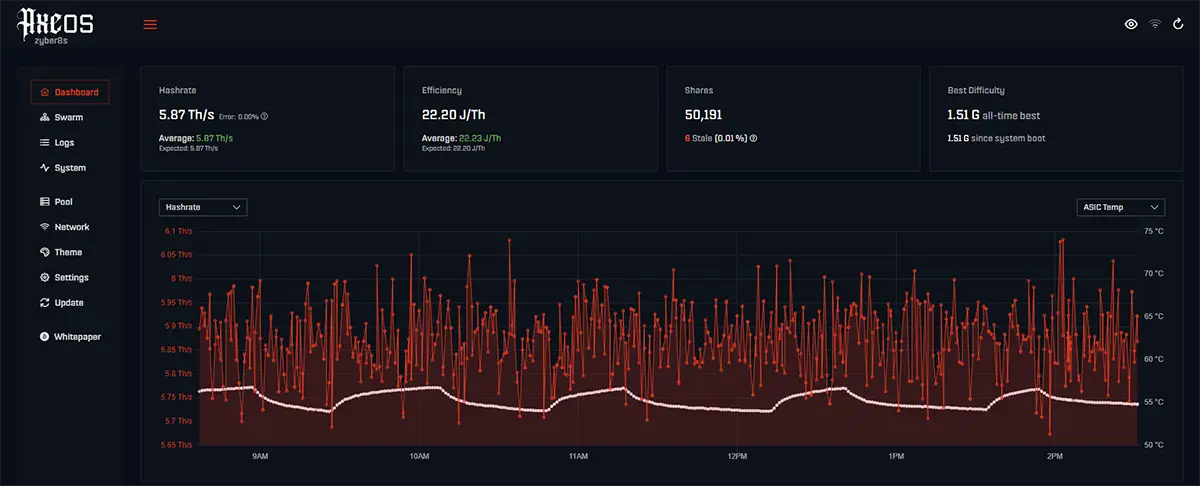
| Rated hashrate | About 6 TH/s in the standard preset (5.87 TH/s average on the unit we serviced, at 575 MHz), 6.4 TH/s and above in the overclock preset per TinyChipHub |
| Cooling type | Copper-aluminum heatsink (plain or graphene-coated), 60 mm fan on the heatsink, 80 mm fan in the base |
| Power input | 12 V DC through an XT30 socket on the board; TinyChipHub's own 12 V 15 A (180 W) supply included. 130 W measured on the unit we serviced in the standard preset; up to about 140 W overclocked per TinyChipHub |
Diagnostic Decision Tree
None of this asks you to do anything. It is here so you know what state the unit is in before deciding to ship it.
| What you see | What it usually means | What we do with it |
|---|---|---|
| Dark display, both fans at full speed, no dashboard | Either a crashed or wrong firmware image, or a failed fan-and-sensor circuit on the board. The two look identical from outside | We boot the unit on the correct factory image first; if it stays dark, we isolate the failed circuit and replace the parts |
Detected 7 ASIC chip(s) or a lower count; hashrate about a chip short |
One BM1368 or one of the four domains failing, often only once the board is warm | We test each domain under load, replace the failed chip, and recalibrate the core voltage |
chip_monitor_task: Chips reset attemp = 1, then 2, then a restart |
On early firmware, a monitoring bug; on current firmware, a chip chain that genuinely stops answering | We rule out the firmware version on the bench, then look at the chain and its domains |
Not available - Power fault or Danger: Low Voltage
|
The supply, the input path, or the on-board power stage is not delivering what the chips ask for | We run the unit from a monitored bench supply and from its own brick, and measure where the drop happens |
| Hashes fine, but the dashboard becomes unreachable and the unit restarts on its own | Usually the firmware version or the Wi-Fi side, rarely hardware | We reproduce it on current firmware for several hours before treating it as a board fault |
Entering safe mode due to overheat condition coming back after every restart |
Heat is not reaching the heatsink, or a fan or a temperature sensor is no longer reporting correctly | We check thermal contact, fan readings and sensor readings under load, and correct what is off |
Diagnostics Focus
- Firmware is separated from hardware before anything is touched. The dominant symptom on this model has two causes that look the same, so every Zyber 8S is first brought up on the correct factory image on the bench. A unit that comes back at that stage is reported to you as a firmware recovery, not as a board repair.
- Fans, sensors and power are checked before the chips. On this board the fan drive, the temperature sensors and the power stage all have to be alive before the ASIC chain even initialises. Chip-level conclusions drawn on a unit that cannot start its fans are worthless, so the chain is the last thing we judge, not the first.
Our Professional Repair Process
Gotchas
- Replacing a part is not the end of the job. After any component-level work on the power or chip side of this four-domain board, the core voltage is recalibrated and the unit is re-run in its own presets. A Zyber 8S that merely powers on after a repair is not a repaired Zyber 8S; the standard we work to is all eight chips reporting and rated output under load.
- Only TinyChipHub's own Zyber 8S image is ever used on the bench. The Zyber 8G image and stock Bitaxe or OSMU builds load onto this board without any warning and can leave it in a worse state than it arrived in. That is also why a unit which failed right after a firmware update is triaged as firmware first, so a wrong image is never mistaken for a dead board.
Typical Service Scenario
- A unit that ran for months on a desk, with the base fan close to the surface and the miner running hot, is found one morning with a dark display and both fans at full speed.
- A firmware update went wrong: a Bitaxe Gamma or Zyber 8G image was loaded, or the update was interrupted, and the unit has not come back since.
- A unit arrives after an earlier repair attempt elsewhere: it powers on, its power draw swings up and down, and it never hashes, and reflashing has not changed that.
What Happens After Intake
- Intake: we record the unit's condition, the firmware version on the display, and the symptoms you reported.
- Incoming inspection: the open board is checked for shipping damage first: the acrylic stand and standoffs, the spring-loaded heatsink mounting, the exposed power terminals, the fan cables and the two fans themselves.
- Diagnostics: the unit is brought up on TinyChipHub's factory image for the 8S; then power delivery, fan drive and temperature sensing are measured; then the chip chain is tested domain by domain under load.
- Component-level repair: failed regulators, fan and sensor circuitry, connectors, damaged traces and failed BM1368 chips are repaired or replaced on the board.
- Cleaning and thermal interface replacement: the board is cleaned and the thermal interface between the chips and the heatsink is renewed before validation.
- Validation: through the unit's own AxeOS dashboard and log, on your pool: all eight chips detected, rated hashrate in the preset the unit came in with, fan and temperature readings normal, followed by a burn-in of at least 2 hours under real mining load. Extended burn-in is available as a separate add-on.

Diagnostics & Validation Equipment
Monitored bench power supply, multimeter fault isolation, thermal imaging under load, and the Zyber 8S's own diagnostic surface: the AxeOS dashboard, its log console and the on-device display. Bench testers built for loose industrial boards do not apply to a complete unit like this one and are not used on it; final validation is the device hashing on a real pool.
All repairs are performed personally by Alex, who has been servicing ASIC miners since 2019. See credentials →
Contact our repair team today and get your miner back to full power.
Technical FAQ
Q: My Zyber 8S screen is black and both fans are running at 100%. Is it bricked or can it be repaired?
Q: I flashed the wrong firmware on my Zyber 8S, a Bitaxe or OSMU image. Can you get it back to factory settings and running again?
Q: My Zyber 8S powers on but is not hashing and reflashing did not help. Do I need to ship it in, or is there something I can fix myself?
Q: My Zyber 8S log keeps showing chip_monitor_task: Chips reset attemp = 1. Is a chip dead?
Q: Do I ship the whole Zyber 8S or just the board?
Q: My Zyber 8S only shows 7 chips and the hashrate dropped to about 5 TH/s. Can one BM1368 be replaced?
Q: TinyChipHub told me to send my Zyber 8S back to Hong Kong for repair. Can a lab in the USA repair it instead?
The miner is running perfectly so far. Thank you again. We’re really appreciate this.