


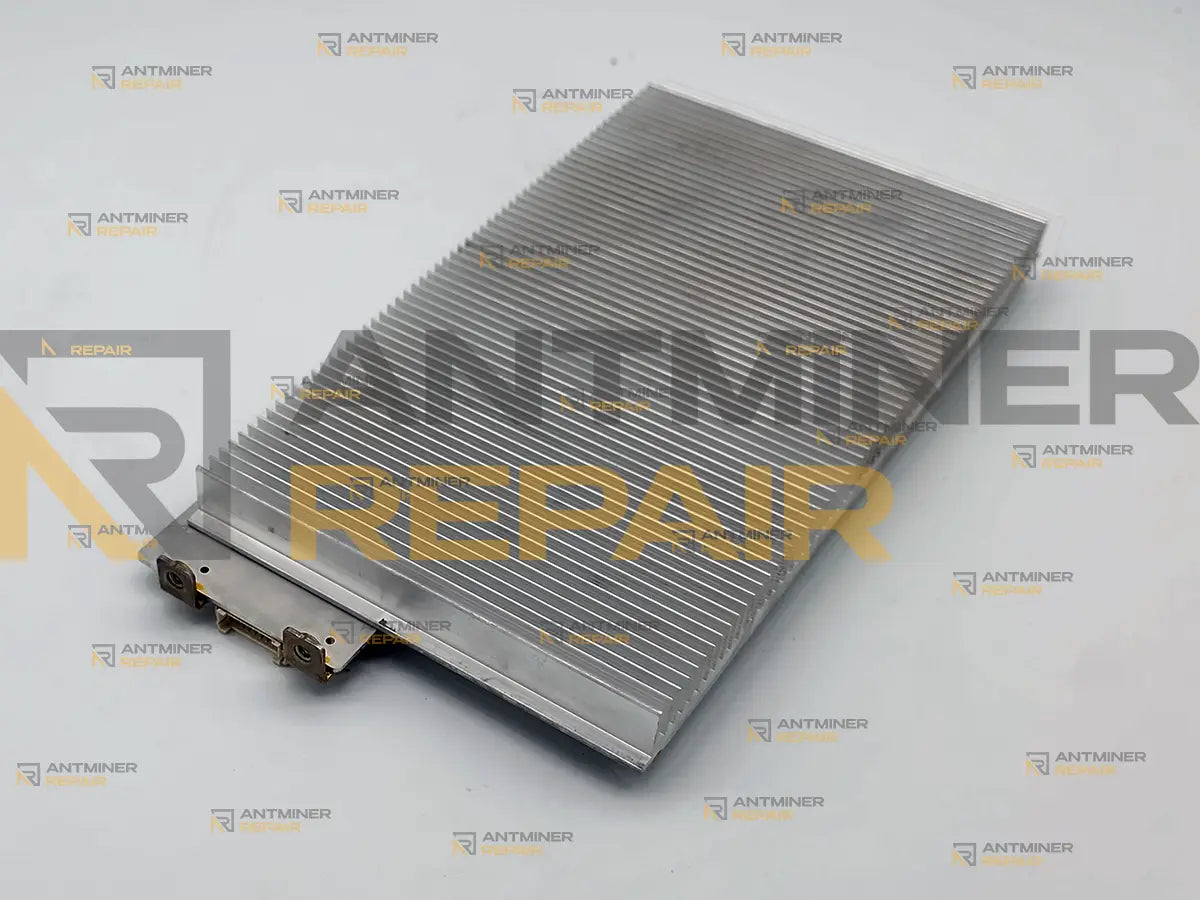
Goldshell SC LITE hashboard repair fixes a board that starts with fewer than 46 chips, throws hardware errors across the chip map, or stops answering while the other three keep hashing. A healthy SC LITE board reports 46 chips and 920 good cores; any other count is a fault. Component-level repair, USA-based, tested under load.
Goldshell SC LITE hashboard repair begins with what the miner writes about itself at startup: how many chips each of its four boards enumerated, and how many good cores came back with them. Those two numbers place the fault before anything is opened, and they are the numbers we work from. The machine carries four boards, so a single failed board costs a quarter of the miner and leaves it running — which is why these arrive one board at a time rather than as a dead machine. Our lab is in the USA and the board never leaves the country.
Technical Diagnostics and Common Issues with Goldshell SC LITE
Quick Symptom Checklist
- The startup line reports a short count, for example
C0: SCLITE Init sucessed. 46 chips, 920 Total goodcores.with a number below 46 or a good-core count below 920 — it is the shape of the line and the numbers in it that matter, not the digits your machine happens to print. - The miner announces fewer boards than it has:
Goldshell-SCLITE Miner detected, 4 chains totally!coming up with three. - The log repeats
C0: Auto addressing failed— the board could not number its own chips. - The log repeats
C0: Init failed 3 Times, Try reboot later!!!orC0: !!!SEND JOB FAILD 10 TIMES, REINIT THIS CPB!!!. - Total hashrate sits near three quarters of the rating with no other symptom.
- The chips page shows a board whose per-chip error counters climb while its neighbours stay quiet.
Model-Specific Patterns We See on Goldshell SC LITE
A full chip count is not a clean bill of health, and on this model that matters more than usual. The miner's own chips page reports a built-in self test per chip alongside a per-chip error counter. A board can come up with all 46 chips answering and every self test passing, and still be the board generating the errors — we have measured exactly that, with one board showing errors from 42 of its 46 chips while another on the same machine showed ten. The count tells you the chips are alive. It does not tell you they are working, and a repair quoted from the count alone is a guess.

Chips fail in pairs, not one at a time. Power reaches the chips in series groups of two, twenty-three groups to a board. A fault inside one chip takes its partner with it, so the good-core total falls in steps rather than drifting, and the chips page shows two neighbours dark instead of one. Diagnosis on this board means finding the failed pair and proving the remaining twenty-two are sound.
Addressing failures look like a dead board and are not always one. Before a board can hash it numbers its own chips along the chain, and when that step fails the log says so plainly rather than reporting a chip fault. The board then retries and re-initialises itself in a loop. A break anywhere in that chain produces the same message, which is why this one is separated on the bench rather than diagnosed from the log alone.
One board short, three still earning. With four boards, a single failure costs about a quarter of the miner's rate and nothing else. Owners routinely run this way for weeks without noticing, and the board arrives after the monthly figures are checked rather than after a breakdown. That delay matters: a board that has been throwing errors for a month is a different job from one pulled the day it failed.
Hardware Notes
| Specification | Details |
|---|---|
| Algorithm and cooling | Blake2B-Sia, air-cooled, four fans |
| Miner hashrate | 4.4 Th/s at 950 W |
| Hashboards per miner | 4, named CPB0 to CPB3 by the miner itself |
| Per-board hashrate | About 1.1 Th/s, so one failed board costs roughly 25 percent of the miner |
| Chips per board | 46, the number a healthy board reports at startup |
| Good cores per board | 920 on a healthy board, which is 20 per chip |
| Chip grouping | 23 series-powered groups of 2 chips |
| Chip family |
ICC590, designed by Intchains. Goldshell publishes no data on the part in its own specification pages. |
| Hashboard marking |
Compute Board V3, printed on the board edge. Goldshell calls the hashboard a compute board throughout its interface and logs. |
| Controller and power | Separate control board and a separate 1500 W supply, both shared across Goldshell's LITE range and both cheaper than a board repair — which is why they are ruled out first. The board takes power through two plain terminals, positive and negative, rather than a PCIe-style plug. |
| Temperature limits | The firmware aims at 89 C and shuts a board down at 95 C. Per-board chip averages in the mid eighties are normal under sustained load. |

What the Log Is Telling You
You do not need to act on any of this. It is here so you know what state the board is in before deciding to ship it.
| What you see | What it usually means | What we do with it |
|---|---|---|
| An init line with fewer than 46 chips | One or more pairs stopped answering when the board came up | We read the board group by group on the bench and establish which pair failed and whether the rest are sound |
| 46 chips but fewer than 920 good cores | Every chip answered, but at least one is running with part of itself disabled | We find which chips are short and decide whether the cause is the chip or what feeds it |
Auto addressing failed |
The board could not number its chips along the chain, which a break anywhere in that chain will cause | We trace where the chain stops rather than treating it as a chip fault |
SEND JOB FAILD and repeated re-initialisation |
The controller is reaching the board but work is not completing on it | We separate the board from the controller and its cabling before quoting, because both produce this |
A temperature line such as C2: Chip Avgtemp 86.000000'C, MaxTemp 93.000000'C, CpbTemp 83.500000'C
|
The board reports its own chip average and peak, which the dashboard never shows. A peak close to 95 C is a board running at its limit | We read these against the same board's error counters, because on this machine the hottest board is usually among the noisiest |
| Error counts that sit on a few chips rather than spreading across the board — on one board we read, nine chips out of forty-six carried 2,459 of its errors while a sister board's two chips carried 77 | The board is not uniformly tired. Individual chips are failing while their neighbours stay clean, and the worst of them also report a lower per-chip performance figure than the rest of the board | We read each chip's error count against its performance figure, so the chips that actually need work are identified before anything is touched — a full count of forty-six is not a clean bill of health |
| One board's error counters climbing while three stay quiet | The board is degrading rather than dead, and it is still hashing while it does | We test it under sustained load, because a board like this often passes a cold check and fails warm |
Diagnostics Focus
The control board and the supply are ruled out before the hashboard, because on this machine they are the cheaper answer. Goldshell sells the control board and the 1500 W supply as ordinary spares across its LITE range, and both cost less than a board repair. Establishing which of the three failed changes what the job costs, not just what it is called, so that is the order we work in.
We read the board per chip, not per board. The miner reports a self-test result and an error counter for every chip it finds, and those two together separate a board that has lost a pair from a board where every chip answers and one region is quietly producing errors. The headline count shows neither.
Our Professional Repair Process
Gotchas
No test fixture for these boards exists on the open market, so we built our own. The bench rigs sold for Goldshell hardware cover the older 5 and 6 series and are sold one family at a time; nothing on the market is offered for this generation. Ours scans the board chip by chip and group by group and reports the counts the miner itself would report, which is what lets us prove a repair rather than assert it. A board is scanned before work starts and again afterwards.
A repaired board has to come back to its own numbers, not merely power on. Because the chips are powered in series pairs, component-level work changes what the rest of the group sees. The question after a repair is whether the board reports its full chip count and its full good-core total and holds them warm — not whether it starts.
Corrosion is where Goldshell itself stops, and we say so before starting. The manufacturer treats boards with corrosion or extensive burn damage as beyond repair and states plainly that a repaired corroded board may corrode and fail again. Where a board arrives in that condition we tell you what can honestly be promised before any work is done.
Typical Service Scenario
- A quarter of the hashrate missing, noticed on the monthly figures. The machine keeps running on three boards, so the loss shows up in the accounting rather than as a failure, and the board reaches us weeks after it went down.
- A board that fails warm and passes cold. It comes up, reports its chips, mines for a while and then starts throwing errors, which is why a short bench check is not the test that matters here.
- Dust and a hot room. Four boards and four fans in a full-size case in a garage or a small farm room, with the intake gradually blocked.
- A machine well out of warranty. Goldshell covers 180 days from shipment and this generation shipped in 2024, so effectively every one of these is outside it. The case also carries an anti-disassembly label, and opening it yourself ends the cover that remains.
What Happens After Intake
- Intake: we record which board it is, what the miner reported before it came out, and the condition it arrived in.
- Incoming inspection: heat damage, contamination, corrosion and connector condition, before anything is powered.
- Diagnostics: a full scan on our own fixture, chip by chip and group by group, then the power path and the chain that numbers the chips.
- Component-level repair: failed chips, power components, sensors, connectors and damaged traces are repaired or replaced where the board allows it.
- Cleaning and thermal service: contamination removed and degraded thermal interface material replaced.
- Validation: the board is scanned again to its full chip and core count, then run for at least an hour in a live miner under load. Extended burn-in is available as a separate service.
Diagnostics and Validation Equipment
Our own bench fixture for these boards, built because none is sold; bench power diagnostics, multimeter fault isolation, microscope work and thermal inspection for the repair itself; and a live miner under load for the result. The fixture reports the same chip count and good-core total the miner reports, so the number on the bench and the number on your screen are the same number.
All repairs are performed personally by Alex, who has been servicing ASIC miners since 2019. See credentials →
Contact our repair team today and get your miner back to full power.