


Antminer S23 hashboard repair is board-level work on a chain that reports 0 ASIC, hashes short, or drops out once the miner is warm. We diagnose failed BM1373 ASICs, collapsed voltage domains, coolant damage under the cold plate, and broken signal paths, then validate the repaired board in a live miner under load.
The S23 line only began shipping in January 2026, so every board in the field is under a year old and most are still inside their warranty window. That timing shapes the work. There is no published S23 teardown, no board schematic, and no chip-level test fixture for BM1373 in existence yet, which means these boards are diagnosed on measurement and architecture rather than on a model-specific service manual. What is knowable about the S23 is knowable precisely, though: the hydro operating envelope, how voltage is regulated across the board, and exactly what the firmware does and does not report. That is what the diagnosis is built on, and this page states plainly which facts are confirmed and which are still open.
Technical Diagnostics and Common Issues with Antminer S23
Quick Symptom Checklist
- Miner comes up with fewer hashboards than it should, or reports one chain as missing
- Kernel log records
Chain 0 only found 0 ASICs, will power off hash board 0 - Partial enumeration such as
Chain[X] only has Y chips- the chain is short rather than absent -
EEPROM read failedorhashboard EEPROM mismatchwhile the chips themselves look intact -
ERROR_POWER_LOST,power fault, orVoltage error, initialization failedon one board only -
Read temp sensor failedorover max tempon a single board while the others stay normal - On S23 Hyd:
Server temperature is too high, with inlet and outlet readings that have converged toward each other - Board hashes from a cold start and falls out of the chain as the loop reaches operating temperature
An important qualification, because nobody else states it: these are the Antminer firmware strings this generation reports, not a documented S23 error table. Bitmain has not published one, and the S23 Hyd product manual ships with no troubleshooting section and no error codes at all. Any site advertising an "S23 error code list" is republishing the S21 generation.
Diagnostic Decision Tree
The same log line comes from several different root causes on this generation. This is the order we work through before a single component is touched.
| Symptom | Likely Cause | What We Check First |
|---|---|---|
| Whole chain reports zero chips and the firmware powers the board off | A collapsed voltage domain, EEPROM data, or a broken signal line upstream of the chips - not necessarily a dead ASIC | Voltage at each domain, EEPROM readability, continuity along the signal path |
| Chain enumerates a partial chip count | One domain lost supply or signal and took its whole block of chips offline together | Which domain stopped responding, then the individual chips inside that domain |
| Board is fine cold and drops out as the loop warms up | A joint or component that only fails under real current and heat, or restricted flow through the cold plate | Behaviour on a live water loop at rated flow, not a cold bench pass |
| Temperature sensor errors on one board while the rest of the miner reads normally | Sensor damage at the inlet end of the board, or a thermal interface that was never reseated correctly | Sensor response independently of chip status, then the condition of the cold plate contact |
| Inlet and outlet temperatures sit almost equal under load | Loss of flow or a blocked cold plate - a cooling fault presenting as a board fault | Flow and coolant condition before any board-level conclusion is drawn |
| Hashrate is a few percent under the number on the box, everything else normal | Batch binning, not a defect - S23 units ship at mixed rated hashrates | The board's own calibration data rather than the model's headline figure |
This narrows the cause before diagnostics begin. It is not a repair guide - domain isolation, EEPROM work, and anything at chip level happens on the bench.
Model-Specific Patterns on the Antminer S23
- Failures arrive one domain at a time. Voltage on an S23 board is regulated per domain rather than per chip, and frequency and voltage targets are calculated by the autotuner at runtime rather than held as fixed presets. One shorted ASIC pulls its whole domain down, and everything downstream of the break stops answering. A short chip count therefore names a domain, not a chip.
- On hydro boards the loop usually kills the board before the board fails. The inlet and outlet temperature sensors sit at the head of the board, and on the hydro generation we already service, abnormal coolant temperature or restricted flow burns those sensors and takes the first domain's supply down with them. The S23 Hyd repeats that architecture, which is why loop condition is treated as part of the diagnosis rather than as background information.
- Coolant contact is silent. Antminer firmware has no leak, flow-rate or pressure alarm - flow is monitored by the cooling infrastructure, not by the miner. By the time an error code appears, fluid has usually been on the board for some time, which is what produces creeping corrosion at domain boundaries and faults that come and go rather than failing cleanly.
- Not every S23 is a 318 TH machine. Retail batches ship at mixed rated hashrates, with 305 TH units alongside 318 TH ones, so a board running a few percent under the headline figure is not a fault on its own. We validate a repaired board against its own calibration data instead of against the number on the box.

Hardware Notes
| Specification | Details |
|---|---|
| Variants covered | S23 air-cooled, S23 Hyd, S23 Hyd 3U, S23 Immersion, S23e Hyd 2U |
| Algorithm and coin | SHA-256, Bitcoin |
| Rated hashrate by variant | 318 TH/s air, 442 TH/s immersion, 580 TH/s Hyd, 1160 TH/s Hyd 3U, 865 TH/s S23e Hyd 2U. Retail batches also ship binned at 305 TH/s |
| Cooling | Air with four fans, liquid, or immersion depending on variant |
| ASIC chip marking |
BM1373AA on the package, read off a chip on our own bench and photographed below. Parts suppliers list the part as BM1373 or BM1373CC, and Bitmain has published no datasheet, so we match against the marking on your board rather than a catalogue designation. Early batches are reported to mix chip revisions |
| Chips per board and domain layout | Not published by Bitmain. Reseller figures currently contradict each other, so we count the chips and map the domains on the board itself and record that on the repair ticket |
| Voltage regulation | Per voltage domain, not per chip. Frequency and voltage are set by the autotuner at runtime rather than by fixed presets |
| Cold plate (hydro variants) | Bolted assembly over the chip face with a thermal interface layer, not soldered. It comes off for inspection and is reseated with fresh interface material afterwards |
| Coolant window (S23 Hyd) | Flow 8.0-10.0 L/min, inlet 20-50 C, pressure up to 3.5 bar, OD10 connectors. Antifreeze, pure water or deionised water, each with its own pH band |
| Board base and part number | Not published. No S23 hashboard part number appears in any public parts catalogue, so we record it from the board at intake |
| Field history | Shipping since January 2026. No public teardown, repair guide or chip-level test fixture exists for this generation yet |


How an S23 Hyd Board Differs from an S21 Hydro
Most operators arriving with an S23 problem describe it in S21 language, because that is the vocabulary the repair world currently has. The physics of hydro failure does carry across: the same coolant chemistry, the same sensors at the head of the board, the same creeping corrosion after fluid contact. The hardware does not. The S23 moves to a different ASIC generation, its domain layout has never been published, and no S21 test fixture or replacement board fits it. So S21 Hydro experience is the right starting point for diagnosis and the wrong basis for parts, part numbers, or a quoted chip count.
Diagnostics Focus
- Diagnosis without a chip-level fixture. Chip testers exist for the previous three Bitmain generations but none supports BM1373, and no universal fixture lists the S23 among its supported boards. We say so rather than implying a tester we do not have. S23 diagnosis runs on kernel-log analysis, voltage measurement across each domain, thermal imaging under load, microscope inspection once the cold plate is off, and the board's behaviour on a live loop at rated flow.
- Separating a board fault from a loop fault. On a hydro machine the board is often the casualty rather than the cause. Converged inlet and outlet readings, discoloured coolant, out-of-band pH and flow below the rated window all point at the installation. A board returned to an untreated loop fails the same way again, so the loop findings go back with the board.
Our Professional Repair Process
Gotchas
- Nothing on a hydro board is visible until the cold plate is off, and taking it off is not free. The plate is bolted rather than soldered, which is the reason these boards are repairable at all, but the thermal interface under it is a consumable. Coolant residue, corroded pads and burnt sensors sit entirely underneath it, so a board can look untouched and be badly contaminated. Any board opened for inspection needs its interface layer redone before it goes back into service, whatever the original fault turned out to be.
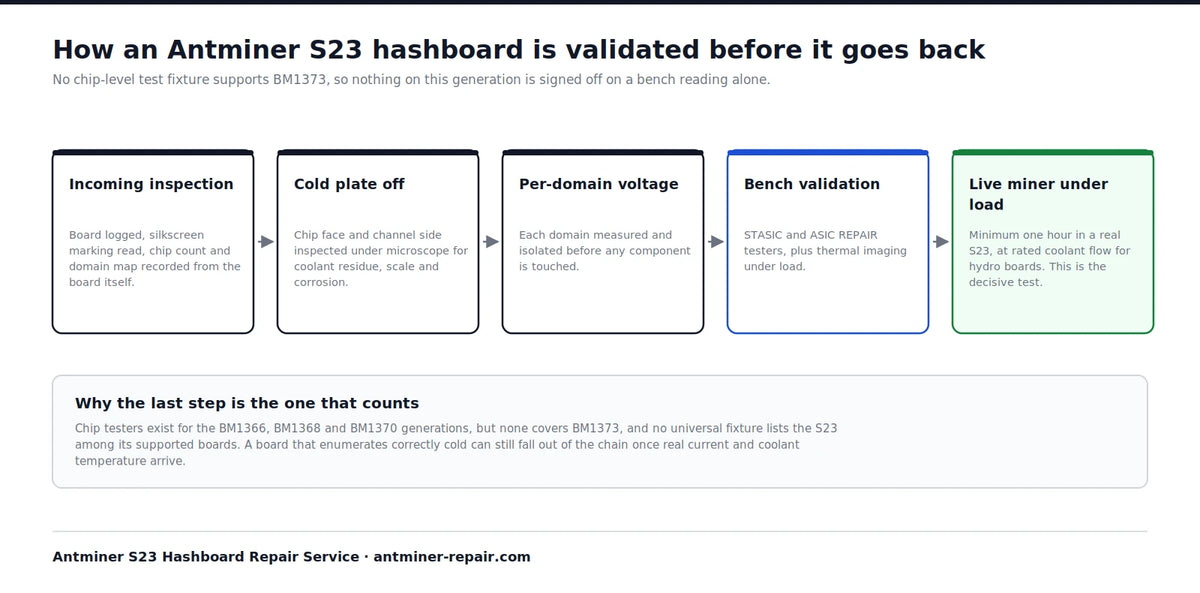
- A bench pass is not a result on this model. Powering a hydro board without its heat path attached destroys chips, and a board that enumerates correctly cold can still fall out of the chain once real current and coolant temperature arrive. Validation on this generation means a live loop at rated flow, not a cold fixture reading.
Typical Service Scenario
- Coolant that was never right to begin with. Tap water instead of deionised water or antifreeze deposits scale in the micro-channels within weeks and drives galvanic corrosion between dissimilar metals, and a falling pH means the corrosion inhibitors are already spent. The board fails months later, from a decision made at commissioning.
- Flow lost or reversed. A failed pump, a partly closed valve, inlet and outlet connected the wrong way round, or a start attempt below the minimum coolant temperature. The miner has no alarm for any of it, so the first sign is usually a board that stops reporting.
- Power event and restart. Cooling and load come back up out of step, chips reach their thermal limit within seconds, and the board arrives with a chain missing after what the owner describes simply as a power cut.
- Damage the warranty does not cover. Bitmain lists 365 days on the S23 line, but coolant neglect, leaks from improper fittings, operation outside the published environmental limits and any non-stock firmware all fall outside it. That is most of what actually reaches a third-party bench on this generation, and it is worth knowing before spending weeks on an RMA that will be declined.
What Happens After Intake
Every board goes through incoming inspection, board-level diagnostics, component-level repair, cleaning, and thermal interface replacement where required. On hydro boards that includes removing the cold plate, inspecting the chip face and the channel side for residue and scale, and reseating the plate with fresh interface material. Bench validation is done on our STASIC and ASIC REPAIR testers, and the board is then run in a real miner under load for a minimum of one hour before it is approved, on a live water loop where the variant requires one. Extended burn-in testing is available as a separate add-on service. Chip replacement is quoted after diagnostics rather than bundled into the base price on this generation, because BM1373 supply is still quote-only: no chips are included in the repair price, and where a failed ASIC is confirmed, each chip is priced as an add-on and fitted only once you approve it. Because S23 units ship at mixed rated hashrates, a repaired board is signed off against its own calibration data rather than against the model's headline number.
Diagnostics and Validation Equipment
Bench work runs on STASIC and ASIC REPAIR testers, which is what makes domain-level isolation practical rather than guesswork across the Bitmain range. For the S23 specifically there is an honest limit worth stating: no chip-level fixture supports BM1373 yet, so nothing on this generation is signed off on a fixture reading alone. The decisive test is the board back in a live S23 under mining load, at rated coolant flow for hydro variants, which is where a board that merely passed cold shows what it really is.

All repairs are performed personally by Alex, 7 years of ASIC repair experience. See credentials →
Contact our repair team today and get your miner back to full power.
Technical FAQ
Q: What does "0 ASIC" mean on an Antminer S23 hashboard?
Q: Can an Antminer S23 Hydro hashboard be repaired, or does the cold plate make it disposable?
Q: My Antminer S23 Hyd never showed a leak error. Does that mean coolant never reached the board?
Q: Is Antminer S23 hashboard repair covered by the Bitmain warranty?
Q: What ASIC chip does the Antminer S23 hashboard use?
Q: Why is there no Antminer S23 test fixture, and how is the board diagnosed without one?
Q: How long does Antminer S23 hashboard repair take compared with sending the miner back to Bitmain?
Related Services
- BM1373 Chip Replacement Add-On (S23)
- Antminer S21 Hydro Hashboard Repair Service
- Antminer S21 XP Hashboard Repair Service
- Antminer S21 Pro Hashboard Repair Service
- Antminer Hydro C59/C89 Control Board Replacement
- Hydro Cold-Plate Thermal Interface Replacement
- Hashboard Cleaning and Maintenance
- Extended Load Testing Before Shipping
- Hydro Miner Maintenance Guide
- Shipping a Hashboard to Our Lab
- What Our Repair Process Covers