

Antminer Repair
Hashboard Recovery Service
Hashboard Recovery Service
By placing your order you agree to our Terms of Service, Warranty Terms and Refund Policy.
Drop off available in Fort Lauderdale, FL (2141 NE 51st Ct).
Repair guide last verified:
▸How to ship your hardware
Share
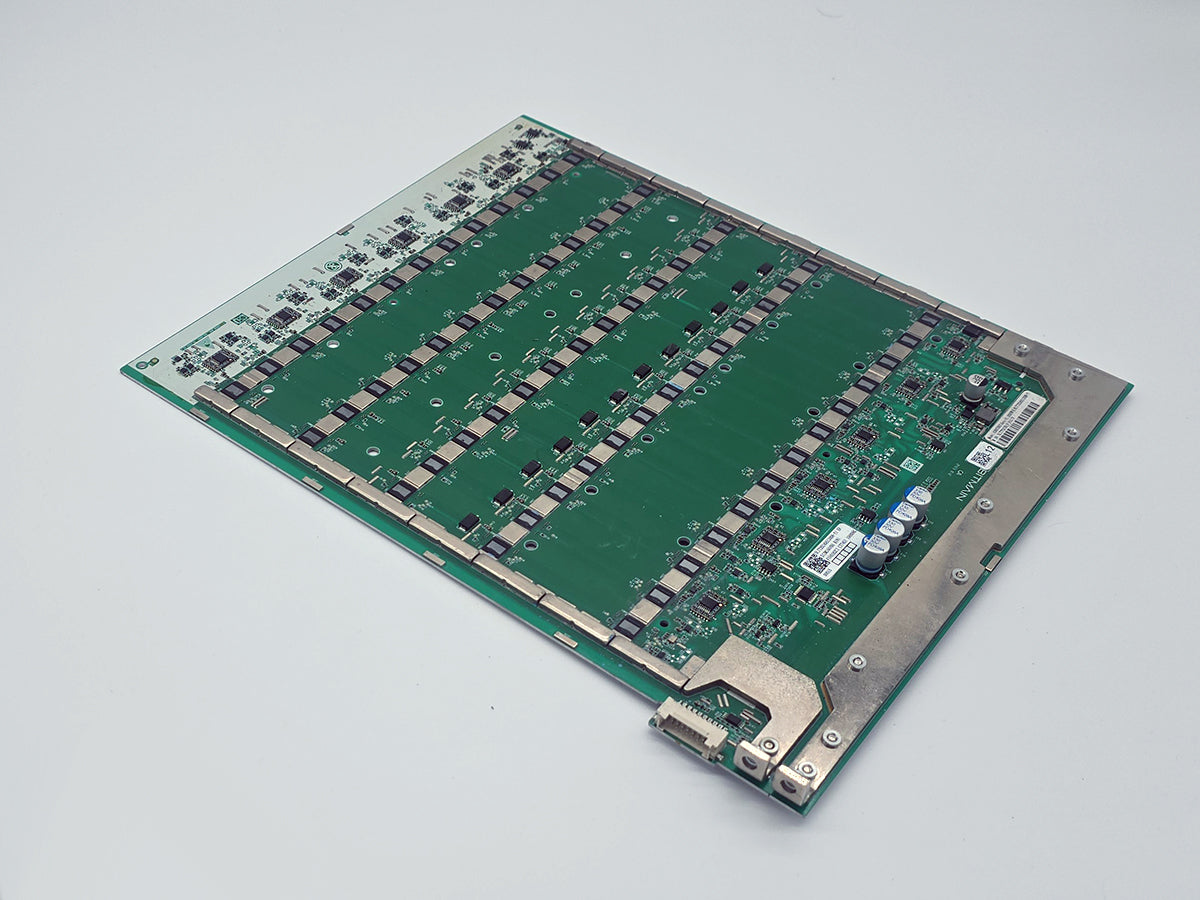
Hashboard Recovery is an add-on to a hashboard repair, not a repair by itself. It covers the work of undoing what an earlier repair attempt left on the board — lifted compound, displaced components, damaged pads — before the original fault can be looked for at all. It is added only after we have the board in front of us.
This line exists because a board that has already been opened somewhere else is not the board a repair price is written for. It is never sold on its own and nothing ships against it: it sits on the invoice next to the repair itself. We do not add it from a photograph or a description — it goes on only after the board is inspected in our USA lab, and we contact you with what we found before any work starts.
What a previous repair attempt leaves behind
The pattern we see most often starts with a board that was heated from the aluminum side while the factory compound was still on it. Heat entering through the plate reaches that compound long before it reaches the joint someone was aiming at. The compound softens, swells and lifts — and the small components sitting under it, along the air intake edge, lift and drift with it.
None of this is visible while the board is hot, and the person doing the work is looking at the other side of it. By the time the board cools, a row of parts is no longer where the factory put it, some of them are no longer attached to anything, and pads have come away with the compound. The board then arrives here with two faults instead of one: whatever sent it out for repair in the first place, plus everything that happened to it on the way.
Why this is a separate line and not part of the repair
Because the board goes through the bench twice.
The first pass is not diagnostics at all. It is putting the board back the way it left the factory: clearing what is left of the compound, returning the displaced components to their own positions and resoldering them, rebuilding pads and traces that came away. Only when the board is in a known state does the second pass begin — finding the fault that the board was sent out for.
A standard hashboard repair is priced for the second pass. It assumes a board nobody has been inside, where the first thing on the bench is a measurement rather than a reconstruction. When that assumption does not hold, the first pass is real work with its own hours, and it is charged as its own line rather than buried in a repair price that was never written for it.
What else brings a board to this line
- Heat damage around a rework area — discoloured laminate, swollen or torn pads.
- Jumper wires and flying leads added by somebody else.
- Leftover solder and flux from previous work, still on the board.
- Components missing, or fitted in the wrong position or the wrong orientation.
- Marks left by an attempt to remove an ASIC that did not finish.
- Traces lifted or cut, and pads that no longer have anything to solder to.
Any one of these can be the reason the board came back from its last stop still not working. All of them have to be dealt with before the original fault means anything.
Aluminum boards and PCB boards are not the same job
On a PCB board there is little compound to fight, and what sits under it can usually be brought back. The recovery work there is mostly cleaning up after someone else and restoring pads.
On an aluminum board the compound is the whole problem, and on 21-series boards it is at its worst. Heat put into the metal spreads across the plate instead of staying where it was aimed, so the compound gives way over an area rather than at a point, and everything sitting in that area moves. A board that was heated hard through the aluminum with the compound still in place is the one case where recovery is sometimes not worth doing at all — and if that is what we find, we will tell you that rather than start.
That difference in work is why there are two options rather than one flat fee. Prices start at $150, and the option that matches your board sets the rest.
How this ends up on your invoice
Nobody adds this line by default, and nothing adds it automatically. The board is inspected physically first, and if it shows outside work, we contact you before starting: what we found, what has to be undone, and what that adds. You decide whether the board goes ahead.
You are most likely to see it if the board has already been to another shop, if it came back from there still not working, or if the soldering was done at home. If you are not sure whether any of that applies, send the board in — this is exactly the thing an incoming inspection is for, and it is settled before any money is committed. What happens to a board after it reaches us is set out on our repair process page.
Some boards do not come back
Not every board survives what was done to it before it got here. Where the damage runs past the point of being worth repairing, we say so directly instead of running hours against a board that will not work at the end of them. What we will not do is take on recovery work quietly and hand back a board with an explanation attached.
Boards we do repair are covered by our standard terms, set out on the warranty page.
All repairs are performed personally by Alex, who has been servicing ASIC miners since 2019. See credentials →
Packing a board properly matters more here than anywhere else — our shipping guide shows how. Contact our repair team today and get your miner back to full power.
Technical FAQ
Q: What is the Hashboard Recovery Service line on my invoice?
Q: How is hashboard recovery different from hashboard repair?
Q: My hashboard was repaired somewhere else and came back not working. Do I need recovery?
Q: Why does hashboard recovery cost more on an aluminum board than on a PCB one?
Q: I tried to fix the hashboard myself. Will you still take it?
Q: Can you tell me before I ship whether my hashboard will need recovery?
Q: Will this be added to my order without asking me?
Q: What happens if my hashboard cannot be recovered?
Related Services
- 5 stars: 1 (100%)
- 4 stars: 0 (0%)
- 3 stars: 0 (0%)
- 2 stars: 0 (0%)
- 1 star: 0 (0%)
I can't say enough about this company! Outstanding work and a great passion for the miners.