


Antminer Repair
Whatsminer M60S Hashboard Repair Service
Whatsminer M60S Hashboard Repair Service
By placing your order you agree to our Terms of Service, Warranty Terms and Refund Policy.
Drop off available in Fort Lauderdale, FL (2141 NE 51st Ct).
Repair guide last verified:
▸How to ship your hardware
Share


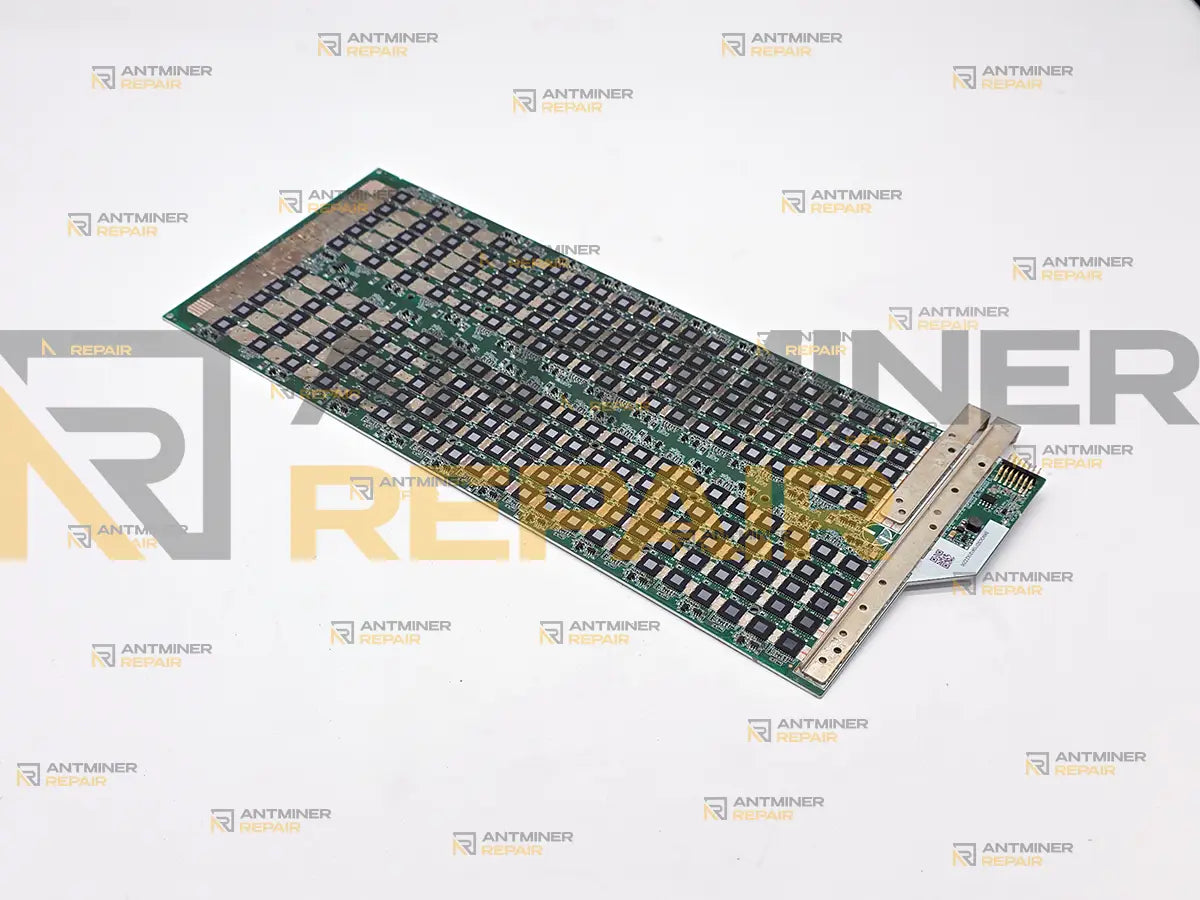
Whatsminer M60S hashboard repair for KF1978E chip failures, reading chip ID errors, missing boards, unstable hashrate, overheating damage, and LDO-related power faults. We perform board-level diagnostics, component-level repair, and load validation for air-cooled M60S hashboards used in 184T, 186T, and 188T miners.
Technical Diagnostics and Common Issues with Whatsminer M60S
Quick Symptom Checklist
- 0 ASIC detected, missing hashboard, or one board not showing in miner status
- “SMX reading chip id error” / 54X fault code
- “SMX not found” / 53X fault code when the miner cannot detect the hashboard correctly
- “SMX have bad chips,” “SMX xfer error chip,” or “SMX reset error”
- Hashrate does not ramp to the expected 184T / 186T / 188T range after startup
- Unstable domains, chain errors, overheating, sensor failures, or abnormal board temperature spread
Model-Specific Patterns We See on Whatsminer M60S
- M60S hashboards that are not detected at all, often caused by signal-chain faults, connector issues, damaged ASICs, or local power problems.
- Boards that start but never accelerate to full hashrate because one or more KF1978E domains are unstable under load.
- Overheated boards where solder joints under selected ASIC chips become unreliable and require controlled reflow or chip-level repair.
- LDO-related failures that prevent proper ASIC initialization or cause unstable chip communication during startup.
Hardware Notes
| Specification | Details |
|---|---|
| Miner model | MicroBT Whatsminer M60S |
| Algorithm | SHA-256 |
| Common hashrate variants | 184T / 186T / 188T |
| Typical efficiency class | Around 18.5 J/TH, depending on batch and profile |
| Hashboards per miner | 3 hashboards |
| ASIC chip marking | KF1978E |
| Chips per board | 215 ASIC chips |
| Domain structure | 43 domains, 5 chips per domain |
| Cooling type | Air-cooled Whatsminer chassis with front-to-back airflow |
| Board base | Aluminum hashboard assembly |
| Heatsink layout | One large bottom heatsink on thermal paste, two top heatsinks on thermal pads |
| PSU platform | P221B on the serviced unit; official M60S listings may show P221B / P222B depending on batch |
| Power cable | IEC C19, 16A or higher |
Diagnostics Focus
- Tracing KF1978E signal-chain communication across all 43 domains to locate bad chips, weak solder joints, or domain-level interruptions.
- Checking LDO outputs, board power stability, connector integrity, and temperature feedback before replacing ASIC chips.
Our Professional Repair Process
Gotchas
- The M60S uses compound near the air intake side. It usually dissolves cleanly, but it still has to be removed carefully before proper diagnostics and repair.
- After overheating, selected KF1978E chips may need controlled reflow or replacement because solder joints can become unreliable under load.
- The top thermal pads are easy to disturb and difficult to reinstall correctly, especially after repeated heat cycles. Naturally, the part most likely to shift is also the part that has to sit perfectly.
Typical Service Scenario
- The miner arrives with one of three hashboards missing or reporting a 53X / 54X board communication fault.
- The M60S starts hashing but never reaches its expected 184T, 186T, or 188T performance because one board or several domains stay unstable.
- The board was exposed to overheating, dust buildup, or poor airflow, causing weak ASIC solder joints and repeated chip ID errors.
What Happens After Intake
After intake, we perform incoming inspection, connector and board inspection, hashboard diagnostics, component-level repair, cleaning, thermal-interface service when required, and validation under load. We check the repaired board with STASIC / ASIC REPAIR diagnostic tools and then run it for at least 1 hour in a real miner. Extended testing is available as a separate service.
Diagnostics & Validation Equipment
We use STASIC and ASIC REPAIR tools to isolate ASIC-chain, LDO, signal, and temperature-related faults before final validation. Bench diagnostics help locate the failure, but the final decision is made in a real M60S miner under load, where weak KF1978E chips, bad solder joints, and unstable domains usually stop pretending to be fine.
Contact our repair team today and get your miner back to full power.