


Yes — Antminer KS7 hashboard repair fixes the most common KS7 fault, a chain reporting fewer than its designed 108 ASICs. On a KS7 board that reading can come from a failed BM2384BA chip, an unstable 1.1-1.2 V domain, EEPROM data, or a broken signal line. Repaired boards are validated under real mining load.
A KS7 board either reports all 108 ASICs or it reports none, and Antminer KS7 hashboard repair begins by working out which of the twelve power domains broke that chain. Bitmain moved this generation onto new silicon and a new control platform, so KS3 and KS5 experience only carries you so far. We diagnose the KS7 on its own architecture, repair at component level, and prove the result under mining load rather than on a bench alone.
Technical Diagnostics and Common Issues with Antminer KS7
Quick Symptom Checklist
- Miner comes up with two hashboards instead of three, or reports a chain as missing
- Kernel log records
error="asic num error" msg="detected asic num less than design(0<108)" - A chain returns a partial count such as
85<108or99<108and is powered off by the firmware - Board hashes for a few minutes after a cold start, then drops out once the miner warms up
- Abnormal temperature readings,
temp sensor read failed, or thermal shutdowns on one board only - Control board log shows a fan at
fanspeed=0(e.g.fanid=1 fanspeed=0, FAN1) - worth ruling out before assuming a board fault - Board is detected on a bench fixture but never initialises inside the miner
Diagnostic Decision Tree
The same log line can come from several different root causes on a KS7. This is the order we check, before any component is touched.
| Symptom | Likely Cause | What We Check First |
|---|---|---|
detected asic num less than design(0<108), whole chain reports zero |
Domain voltage, EEPROM data, or signal line fault upstream of the chips - not necessarily a dead chip | Domain voltage per domain, EEPROM read at the signal connector, signal line continuity |
Partial count, e.g. 99<108 or 85<108
|
One of the 12 domains lost power or signal, taking its 9 chips offline as a block | Which domain stopped responding, then the 9 chips inside that domain individually |
| Full 108/108 on a bench fixture, drops out once the miner reaches operating temperature | Cold pass, warm failure - a connection or component that only fails under real current and heat | Behaviour under load in a live miner, not just a cold fixture pass |
| Zero ASICs detected, chips visually intact under inspection | EEPROM, clock/reset line, or connector corrosion producing the same log line as a dead chip | EEPROM integrity and connector condition before any chip is suspected |
temp sensor read failed, thermal shutdown on one board only, or a control-board log showing a fan at fanspeed=0
|
Sensor fault or thermal interface issue on that board - or simply a stalled fan raising case temperature, which is not a hashboard fault at all | Fan RPM at each position first, then sensor response independently of chip domain status |
| Board detected on a bench fixture, never initialises inside the miner | Communication mismatch between the hashboard and the Amlogic control board | Signal path and connector between hashboard and control board |
This table narrows down the likely cause before diagnostics begin. It is not a repair guide - domain isolation, EEPROM checks, and chip-level work are performed on the bench with STASIC and ASIC REPAIR testers, not at home.
One real example from the field: a control board log reading fanid=1 fanspeed=0, referencing FAN1, looks like a board-level thermal fault at first glance. It is the cooling fan itself, not the hashboard. Confirming fan RPM at each position before assuming a board defect avoids paying for chip-level repair when a fan replacement would have solved it.
Model-Specific Patterns We See on Antminer KS7
- Cold pass, warm failure. KS7 boards frequently show a full chip count on a fixture and then fall out of the chain once real current and case temperature arrive. This is the dominant pattern on the model.
- Failures arrive nine chips at a time. The 108 chips are grouped into 12 domains of 9. A single unstable domain removes nine ASICs at once, and everything downstream of the break stops answering.
- Partial detection is not a working board. KS7 firmware powers the chain off unless all 108 chips respond, so there is no reduced-hashrate fallback to run on while you decide what to do.
- Zero ASICs with physically intact chips. Domain voltage, EEPROM at the signal connector, clock and reset lines, connector corrosion, or fatigued solder joints all produce the same log entry as a dead chip.

Hardware Notes
| Specification | Details |
|---|---|
| Miner model | Bitmain Antminer KS7 (36 / 40 / 45 TH/s bins) |
| Algorithm / coin | kHeavyHash / Kaspa (KAS) |
| Hashboards per miner | 3 boards, 324 ASIC chips in total |
| ASIC chips per board | 108 |
| ASIC chip marking | BM2384BA |
| Domain structure | 12 domains, 9 chips per domain, approximately 1.1-1.2 V per domain |
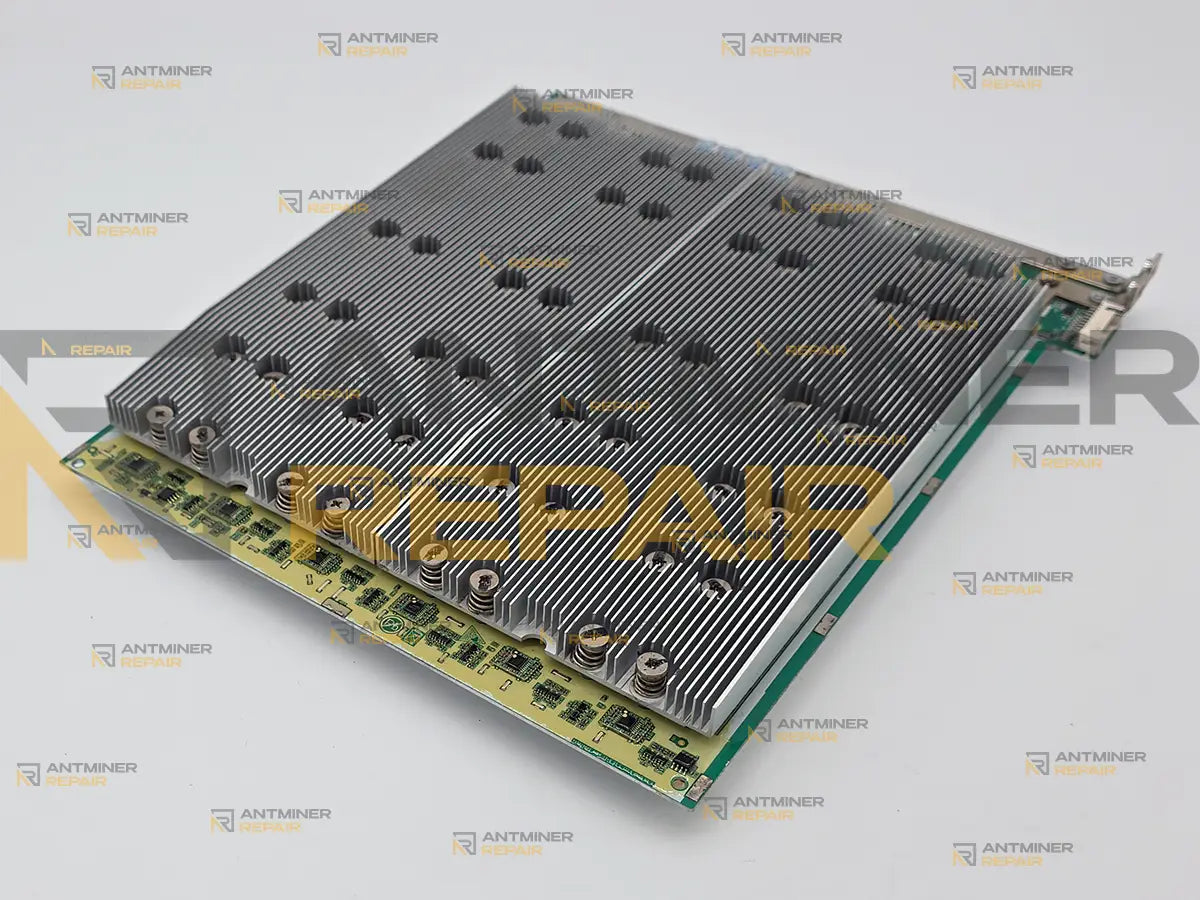
| Board base and cooling stack | Aluminium substrate, 5 heatsinks per board: 3 below and 2 above the PCB |
| Power and control components | No on-board VRM; EEPROM located next to the signal connector |
| Hashboard part number | A3KK34601, revision V1.1010 |
| Control board platform | Amlogic. KS3 and KS5 use Cvitek, so control boards and firmware are not interchangeable with the KS7 |
| Cooling type | Air-cooled, 4 fans |

Diagnostics Focus
- Domain isolation before chip work. A short chip count on a KS7 names nothing on its own. We separate domain behaviour, EEPROM, and the signal path from actual chip failure before a single BM2384BA is touched, because replacing silicon on a guess is how a repairable board becomes scrap.
- Behaviour under real heat and current. Since the model's signature fault appears only when warm, diagnostics aim to reproduce the failure at operating temperature rather than confirm a board looks fine cold.
Our Professional Repair Process
Gotchas
- Opening a KS7 board to "just look" is not reversible. Five heatsinks come off, three from below and two from above, and the thermal interface then has to be reapplied on both faces of the PCB. Boards that reach us after a home inspection always need the full thermal stack redone, regardless of the original fault.
- A bench pass proves very little on this model. A KS7 board can report all 108 chips on a fixture and still drop out minutes after the miner reaches operating temperature and full current draw, which is why bench validation alone is never the last step here.
Typical Service Scenario
- The miner boots with two boards, logs
asic num erroron the third, and hashrate settles at roughly two thirds of normal. - A board arrives after a supply fault or hard power loss. Worth noting that a chain lost this way is not always the board, so power supply behaviour is checked before any board-level conclusion.
- The board has run in dusty air. The KS7 carries a clear plastic shield bonded along the front edge, and as the photo above shows, it slows contamination down rather than stopping it, so dust and corrosion still reach the components over time.
- Humid or coastal installations, where oxidised connectors and signal lines read as a chain fault while the chips themselves are intact.
What Happens After Intake
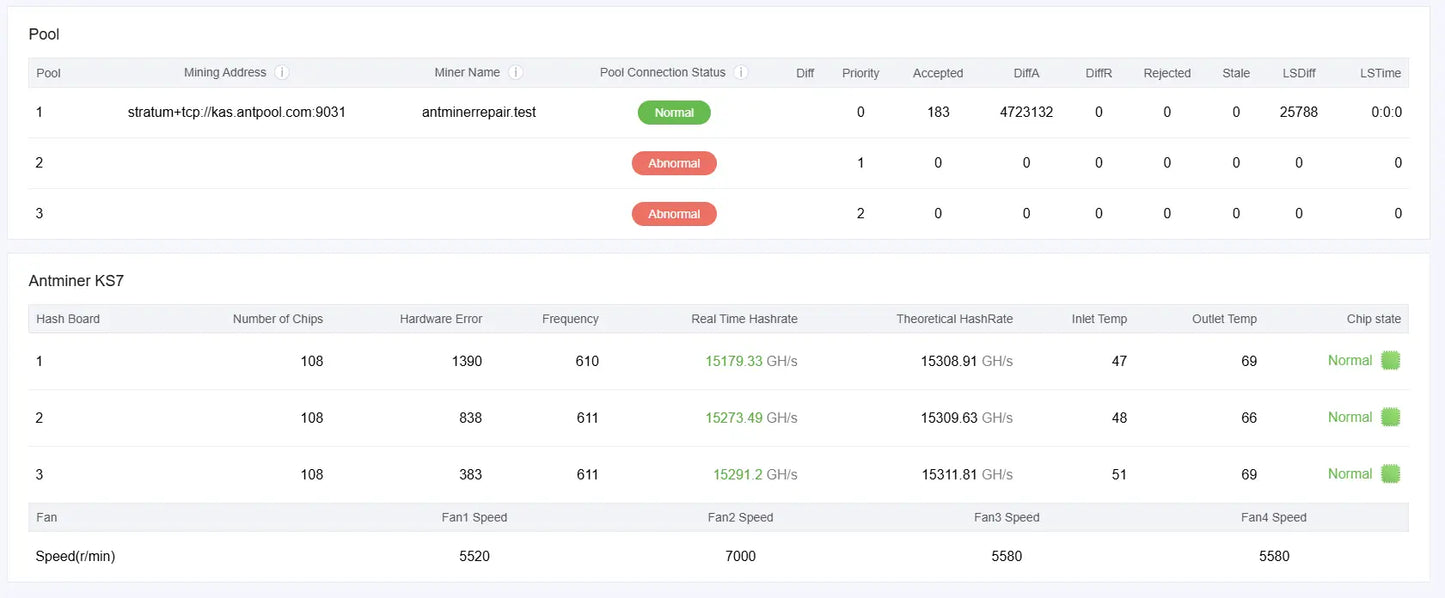
Every board goes through incoming inspection, board-level diagnostics, component-level repair, cleaning, and thermal interface replacement where required. Bench validation is done on STASIC and ASIC REPAIR testers, then the board is run in a real miner under load for a minimum of one hour before it is approved. Extended burn-in testing is available as a separate add-on service. The service covers diagnostics, component-level repair, and one BM2384BA ASIC replacement where diagnostics confirm a failed chip; any additional chips are quoted separately at current supplier pricing, since BM2384BA availability fluctuates.
Diagnostics and Validation Equipment
Bench work is done on STASIC and ASIC REPAIR testers, which is what makes domain-level isolation on a 108-chip board practical rather than guesswork. Final validation always happens in a live KS7 under mining load, because this is the point at which a cold-passing board reveals whether it was actually repaired.

All repairs are performed personally by Alex, who has been servicing ASIC miners since 2019. See credentials →
Contact our repair team today and get your miner back to full power.
Technical FAQ
Q: How many ASIC chips does an Antminer KS7 hashboard have?
Q: My Antminer KS7 logs "asic num error, detected asic num less than design(0<108)" - what does that mean?
Q: Will an Antminer KS7 hashboard still run if only a few chips are missing?
Q: Is ASIC chip replacement included in the Antminer KS7 hashboard repair price?
Q: Can custom firmware recover a weak Antminer KS7 hashboard?
Q: Is the Antminer KS7 the same hashboard as the Antminer K7?
Related Services
- BM2384BA Chip Replacement Add-On (KS7)
- Antminer KS5 Hashboard Repair Service
- Altcoin Antminer Hashboard Repair
- EEPROM Repair for Antminer Hashboards
- Hashboard Cleaning and Maintenance
- Mining Power Supply Repair
- ASIC Chip Compatibility by Miner Model
- How to Ship Your ASIC for Repair
- How the Repair Workflow Runs